Hover or tap a word to see its match.
Nymphs, whose sacred race is from the fountains,
You who inhabit the health-giving retreats,
And the grove gushing with streams, and the waters
Warm with sulfur.
Behold, I vow six hundred garlands to you,
For the return of my Stibarus,
That he may seek again his own home
Safe from your waters.
He who, the great pillar of my affairs,
Bids me here, freed from cares,
To compose a sweet song with the lyre
Among the fragrant herbs.
May the whispering zephyrs and the light breezes,
Companions of the shady spring, venerate him
Everywhere while he returns, and may the South Wind
Not stir up showers.
I myself will diligently weave baskets
Of leafy hibiscus and slender rush;
Bound by my vow, I will immediately heap
Your altars with these.
Now it is enough to give rosemary and marjoram
And the foliage of savory; afterwards I will also
Offer dewy myrtles and the shoots
Of Apollo's laurel.
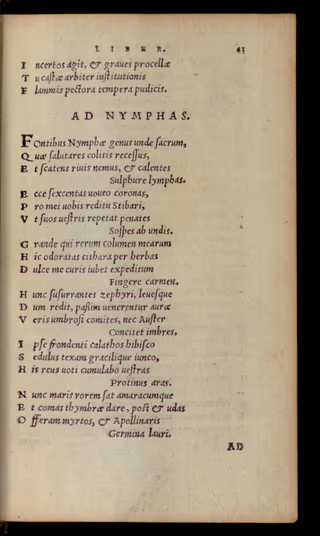
Fontibus Nymphæ genus unde ſacrum,
Q uæ ſalutares colitis receſſus,
E t ſcatens riuis nemus, & calentes
Sulphure lymphas.
E cce ſexcentas uoueo coronas,
P ro mei uobis reditu Stibari,
V t ſuos ueſtris repetat penates
Soſpes ab undis.
G rande qui rerum columen mearum
H ic odoratas cithara per herbas
D ulce me curis iubet expeditum
Fingere carmen.
H unc ſuſurrantes zephyri, leueſque
D um redit, paſsim uenerentur auræ
V eris umbroſi comites, nec Auſter
Concitet imbres.
I pſe frondenti calathos hibiſco
S edulus texam gracilique iunco,
H is reus uoti cumulabo ueſtras
Protinus aras.
N unc maris rorem ſat amaracumque
E t comas thymbræ dare, poſt & udas
O fferam myrtos, & Apollinaris
Germina lauri.