Hover or tap a word to see its match.
While the icy sky is stiff with winter's cold,
I make a journey in the time of midnight.
The way is not known to me, nor do the stars provide light,
and deep snow lies from the Sarmatian North Wind.
Therefore, Cynthia, ruler of the frosty night,
dutifully turn your face hither.
A weighty cause compels me to go through places full
Of uncertain fear, while all things are covered in darkness.
But what good is it to me that you shine with a full shape,
When you cover your bright face with thick clouds?
Perhaps you are ashamed to show the spots of your rosy face,
Though you are more comely with a multi-colored orb.
The Goddess who begins the journey of ethereal light,
Clothed in a purple mantle, does not surpass you.
Nor does the mother of love, preferred to the two on Ida,
(I speak with Venus's leave) have such a face.
Drive forth your chariot bearing radiant light,
And do not earn to be called the cause of my death.
I do not fear swords, nor the violent jaws of wolves,
Even though the Hercynian forest is not far from there.
But who will grant that I surmount the heaped-up snows
In this darkness (I call you, deep silences, to witness)?
I see no tracks of feet, none of wheels,
And the whole sky lies hidden by pitch-black clouds.
And now my body is exhausted by the winding of uncertain paths,
And my limbs are stiff with cruel cold.
Why, however, do you enviously withdraw yourself from my sight?
And when you could lighten such great evils, do you make them heavier?
But I remember when, relying on the gift of the blind night,
I was recently about to hang garlands on the doors as a lover:
You removed all the clouds from the cleared sky,
And betrayed by you, I was the talk of the town in the morning.
Now shine with pure rays, O Latonian offspring,
If you lack them, what will be your use?
Am I deceived? Or have you been drawn down from the sky by magic arts,
And do spell and herb drag you down against your will?
Now I could wish the air to resound with hollow ringing,
So that they might bring help, since they are thought to bring it.
I am mistaken, the Latmian shepherd detains you on the accustomed grass,
Forgetful of mounting your horses again.
You sprinkle him with violets in your embrace, and carefully tend him,
While sleep stands before his rosy cheeks.
Mount your chariot again, O most beautiful sister of Phoebus,
Or does sleep, soothing the young man, hold you as well?
Behold, at last pitying our labors,
The lesser stars dapple the azure paths.
Already the golden Tegean maiden shines, and the guardian who,
Snatched from the Arcadian ridges, came to the stars.
And Andromeda, not yet released from her chains,
And her father Cepheus, and her mother Cassiope:
And Perseus, who once, cleaving the breezes with the winged sandals given him,
Made his way through the clear air.
I do not desire wings to be flapped upon my shoulders,
Only scatter your radiance, I will not be sluggish.
Humid night has reached either the middle turning-posts or beyond,
And the Pleiad enters the waters of the western sea.
And the Dolphin, who carried Arion, ascends the zenith,
Always prepared to bring help to poets.
Reveal your conspicuous face now, O most full one,
Reveal it, and do not, cold one, spare my head.
So may neither the murmurs of a magic tongue confound you,
Nor the dire herbs born on Haemonian ridges.
Nor may the evil contagions of the neighboring earth harm you,
And may your light horses always be nourished with ambrosia.
I myself will speak of your powers and your names,
A thousand powers, a thousand names I will sing.
And now, as the clouds are cleared away, you emerge silvery;
The ground shines, struck by the reflected light.
Oh, if only the breezes would favor me, with the North Winds driven away,
While it pleases me to recount your praises in order.
You, venerable queen of the heavens, with the stars following,
Lead the conspicuous choirs in the glowing vault.
And although, out of all that the golden ether sustains,
You look upon the lands from a closer place:
Yet it is your doing that the restless stars, along with the fixed ones,
Are known, and are not carried along unobserved.
And none can outstrip you in rapid course,
Although the highest orbit often delays the journey.
Nor is he equal to you, even though he binds winged sandals to his feet,
The grandson of great Atlas and Pleione.
This too, that he shares his glowing fires with you,
The Sun, the eye of the world, is your great glory.
You filled the years of ancient time with months,
While the people were wise, while the world was new.
You take on various faces by renewing your horns,
And you possess the choice of a freer path.
For sometimes you seek the cold Triones with the harsh North Wind,
Now you seek the constellations closest to the damp South Wind.
Thus, for those to whom you usefully provide your fires as they are born,
You do not allow them to be obscure and have no praise.
You also know (and it is not your fault), you know, excellent Phoebe,
Why I am so often forced to embark upon long journeys.
Your power regulates what the sky and what the great air contain,
And it governs the lands and the waters.
From this, Amphitrite surges with ebbing waves,
As the sea at first gradually falls back.
Hence the flock, and the watery race, and the tuneful birds,
And whatever the earth creates, are wont to flourish.
You fill all things with juices that increase their strength,
And you nourish seeds fit for things to be born.
Let no one persuade me to use the arts of Phoebus,
Unless your favor first gives certain signs.
Nor to graft tender branches into the cleft bark,
Nor carefully prune the spreading foliage with a sickle.
Why should I mention how to sailors, and those cultivating pleasant fields,
You, when pale, signify rain, and when red, the South Winds?
You can release the heavenly waters from the clouds,
You can unlock the doors of Aeolus' prison.
You also take away the burden of the heavy womb for those giving birth,
Whence you rightly have the name of light.
You are the brightest goddess of the world placed under the earth,
Persephone, joined to the brother of Jove.
Nor is your wrath light; he whom you press with your swelling face
Falls forward, foams at the mouth, and strikes the ground with his foot.
Goddess, ruler of the groves, and vanquisher of wild beasts,
May it please you to be fierce to Armenian tigers.
Cause all fear to vanish into the empty air,
And favor good mortals, you who are not to be feared.
But it is well; he comes (behold) he comes, the nourishing light approaches,
The bright morning star comes from the Eastern world.
Hail, Lucifer, glory of the stars, and let the mother of black
Memnon arise from the sea and go forth under your guidance.
I myself, after a wakeful night, will give the daylight to rest:
Thus the night is finished, and the journey; Moon, farewell.
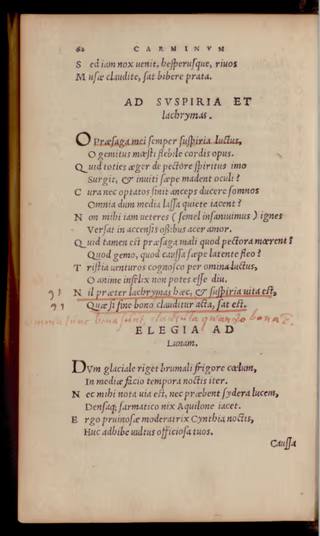
Dvm glaciale riget brumali frigore cælum,
In mediæ facio tempora noctis iter.
Nec mihi nota uia eſt, nec præbent ſydera lucem,
Denſaq; ſarmatico nix Aquilone iacet.
Ergo pruinoſæ moderatrix Cynthia noctis,
Huc adhibe uultus officioſa tuos.
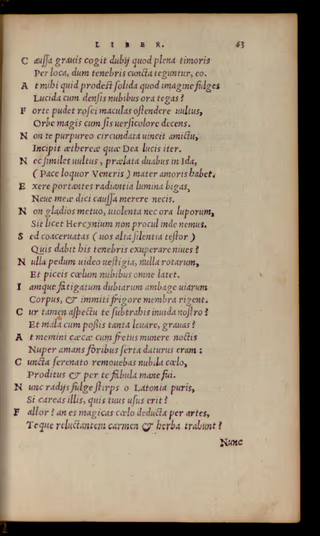
Cauſſa grauis cogit dubij quod plena timoris
Per loca, dum tenebris cuncta teguntur, eo.
At mihi quid prodeſt ſolida quod imagine fulges
Lucida cum denſis nubibus ora tegas?
Forte pudet roſei maculas oſtendere uultus,
Orbe magis cum ſis uerſicolore decens.
Non te purpureo circundata uincit amictu,
Incipit æthereæ quæ Dea lucis iter.
Nec ſimiles uultus, prælata duabus in Ida,
(Pace loquor Veneris) mater amoris habet.
Exere portantes radiantia lumina bigas,
Neue meæ dici cauſſa merere necis.
Non gladios metuo, uiolenta nec ora luporum,
Sit licet Hercynium non procul inde nemus.
Sed coaceruatas (uos alta ſilentia teſtor)
Quis dabit his tenebris exuperare niues?
Nulla pedum uideo ueſtigia, nulla rotarum,
Et piceis cœlum nubibus omne latet.
Iamque fatigatum dubiarum ambage uiarum
Corpus, & immiti frigore membra rigent.
Cur tamen aſpectu te ſubtrahis inuida noſtro?
Et mala cum poſsis tanta leuare, grauas?
At memini cæcæ cum fretus munere noctis
Nuper amans foribus ſerta daturus eram:
Cuncta ſerenato remouebas nubila cœlo,
Proditus & per te fabula mane fui.
Nunc radijs fulge ſtirps o Latonia puris,
Si careas illis, quis tuus uſus erit?
Fallor? an es magicas cœlo deducta per artes,
Teque reluctantem carmen & herba trahunt?
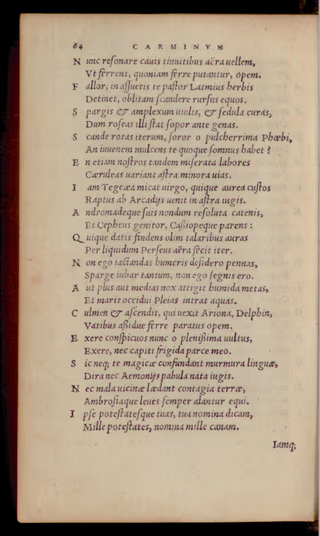
N unc reſonare cauis tinnitibus aëra uellem,
Vt ferrent, quoniam ferre putantur, opem.
F allor, in aſſuetis te paſtor Latmius herbis
Detinet, oblitam ſcandere rurſus equos.
S pargis & amplexum uiolis, & ſedula curas,
Dum roſeas illi ſtat ſopor ante genas.
S cande rotas iterum, ſoror o pulcherrima Phœbi,
An iuuenem mulcens te quoque ſomnus habet?
E n etiam noſtros tandem miſerata labores
Cæruleas uariant aſtra minora uias.
I am Tegeæa micat uirgo, quique aurea cuſtos
Raptus ab Arcadijs uenit in aſtra iugis.
A ndromadeque ſuis nondum reſoluta catenis,
Et Cepheus genitor, Caßiopeque parens:
Q uique datis findens olim talaribus auras
Per liquidum Perſeus aëra fecit iter.
N on ego iactandas humeris deſidero pennas,
Sparge iubar tantum, non ego ſegnis ero.
A ut plus aut medias nox attigit humida metas,
Et maris occidui Pleias intrat aquas.
C ulmen & aſcendit, qui uexit Ariona, Delphin,
Vatibus aßidue ferre paratus opem.
E xere conſpicuos nunc o plenißima uultus,
Exere, nec capiti frigida parce meo.
S ic neq; te magicæ confundant murmura linguæ,
Dira nec Aemonijs pabula nata iugis.
N ec mala uicinæ lædant contagia terræ,
Ambroſiaque leues ſemper alantur equi.
I pſe poteſtateſque tuas, tua nomina dicam,
Mille poteſtates, nomina mille canam.
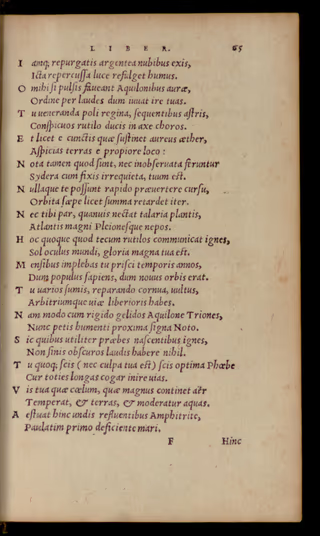
Iamq; repurgatis argentea nubibus exis,
Icta repercuſſa luce refulget humus.
O mihi ſi pulſis faueant Aquilonibus auræ,
Ordine per laudes dum iuuat ire tuas.
Tu ueneranda poli regina, ſequentibus aſtris,
Conſpicuos rutilo ducis in axe choros.
Et licet e cunctis quæ ſuſtinet aureus æther,
Aſpicias terras e propiore loco :
Nota tamen quod ſunt, nec inobſeruata feruntur
Sydera cum fixis irrequieta, tuum eſt.
Nullaque te poſſunt rapido præuertere curſu,
Orbita ſæpe licet ſumma retardet iter.
Nec tibi par, quanuis nectat talaria plantis,
Atlantis magni Pleioneſque nepos.
Hoc quoque quod tecum rutilos communicat ignes,
Sol oculus mundi, gloria magna tua eſt.
Menſibus implebas tu priſci temporis annos,
Dum populus ſapiens, dum nouus orbis erat.
Tu uarios ſumis, reparando cornua, uultus,
Arbitriumque uiæ liberioris habes.
Nam modo cum rigido gelidos Aquilone Triones,
Nunc petis humenti proxima ſigna Noto.
Sic quibus utiliter præbes naſcentibus ignes,
Non ſinis obſcuros laudis habere nihil.
Tu quoq; ſcis (nec culpa tua eſt) ſcis optima Phœbe
Cur toties longas cogar inire uias.
Vis tua quæ cœlum, quæ magnus continet aër
Temperat, & terras, & moderatur aquas.
Aeſtuat hinc undis refluentibus Amphitrite,
Paulatim primo deficiente mari.
H inc pecus, æquoreumq; genus, uolucreſq; canoræ,
Quæq; creat tellus, luxuriare ſolent.
O mnia tu ſuccis uires augentibus imples,
Aptaque naſcendis ſemina rebus alis.
N ec mihi quis Phœbi perſuadeat artibus uti,
Ni tuus haud dubias det fauor ante notas.
C ortice nec fiſſo teneros inſigere ramos,
Nec patulas cura cædere falce comas.
Q uid loquar ut nautis, & amœna colentibus arua,
Significes imbres pallida, rubra Notos?
T u potes æthereas abrumpere nubibus undas,
Carceris Aeolij tu reſerare fores.
T u quoq; uentris onus grauidi parientibus aufers,
Vnde datæ merito nomina lucis habes.
T u dea ſub terra poſiti clarißima mundi,
Perſephone fratri conſociata Iouis.
N ec leuis ira tua eſt, quem tu premis ore tumenti
Pronus agit ſpumas, & pede tundit humum.
D iua potens nemorum, debellatrixq; ferarum,
Te iuuet armenijs tigribus eſſe trucem.
F ac timor ut uacuas omnis uaneſcat in auras,
Humaniſq; faue, non metuenda bonis.
S ed bene habet, uenit (ecce) uenit, lux alma propin=
Clarus ab Eoo lucifer orbe uenit. (quat,
L ucifer aſtrorum ſalue decus, ortaq; nigri
Memnonis a pelago te duce mater eat.
I pſe dabo lucem, uigilata nocte, quieti:
Nox ita finita eſt, & uia, Luna uale.