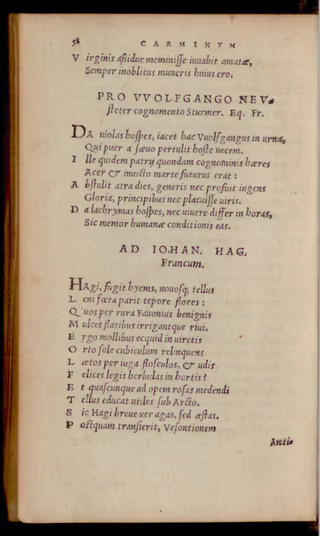
PRO VVOLFGANGO NEV- ſteter cognomento Sturmer. Eq. Fr.

Poet
Lotichius
Book
Poemata , 1561
Form
Elegiac couplet
Open the page in the book
The page this poem fills. Each opens in the Poemata reader.

Hover or tap a word to see its match.

Give violets, stranger; in this urn lies Wolfgang,

Who as a boy suffered death from a cruel enemy.

He indeed, destined to be the heir of his father's surname,

Was to be fierce and invincible in war:

A dark day carried him off, and neither the huge

Glory of his lineage helped him, nor having pleased princely men.

Give tears, stranger, and do not put off living from hour to hour;

Thus may you go on your way, mindful of the human condition.

D a uiolas hoſpes, iacet hac Vuolfgangus in urna,

Qui puer a ſæuo pertulit hoſte necem.

I lle quidem patrij quondam cognominis hæres

Acer & inuicto marte futurus erat :

A bſtulit atra dies, generis nec profuit ingens

Gloria, principibus nec placuiſſe uiris.

D a lachrymas hoſpes, nec uiuere differ in horas,

Sic memor humanæ conditionis eas.
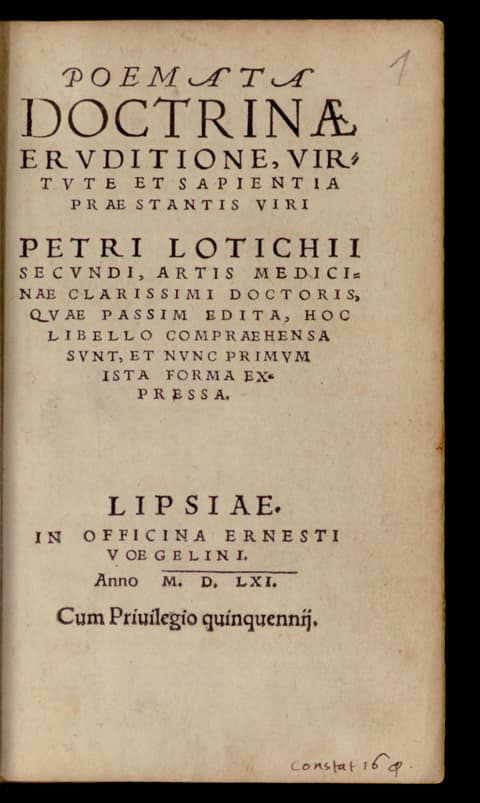
Title page of Poemata
Title page of Poemata , 1561

About this text

Provenance

This digital edition is derived from the Bayerische Staatsbibliothek digitization of the 1561 Leipzig edition of Petrus Lotichius Secundus's Poemata.

Methodology

Each scan is treated as a page-level unit. The page image remains the authority for the edition. Local Kraken OCR was used as a Latin early-print reading aid, then Gemini generated scan-grounded Latin transcription and English translation from the images, the OCR aid, and the approved glossary. Word links connect the English translation to the Latin transcription and locations on the scans. 62 uncertain word-link decisions remain unlinked. Some links highlight only the text because the source word could not be located on the scan.

Rights

The BSB IIIF manifest declares the digital surrogate under the Public Domain Mark 1.0. Poet Doctor's presentation adds generated OCR, transcription, translation, navigation metadata, and editorial context.

Original scans: Bayerische Staatsbibliothek ( Public Domain Mark 1.0 ).

Historian’s note. This text records the medicine of its own time, and later evidence has replaced most of it. It is not medical advice. We read it as history, and we ask what, if anything, connects it to medicine today. More on how we read old medical books