Hover or tap a word to see its match.
We say that there are three species of Aristolochia.
The first is called long, whose root is long.
In its virtues, this is said to be almost equal to the round.
The following is called round, which has a round root.
The third is called clematis in the Greek language.
All are read to have a hot and dry virtue:
The virtue is dry in the first degree, and hot in the second.
Taken with wine, the round cures pestilential bites,
And thus drunk, it benefits against ingested poisons.
And taken in this manner, it brings out the delayed afterbirth.
With myrrh and pepper, it cleanses the womb from all putrefaction
When drunk after childbirth, or merely applied as a suppository.
It benefits asthmatics, and taken, it repels chills.
It cures pleuritics if it is taken with water mixed in.
With the liquor of honey, it cleanses wounds and fills them.
Pounded and added on top, it draws out any embedded object.
But if you add iris to the aforestated things, and with it
Anoint the gums, it cleanses the teeth from putrefaction.
It resolves hardness of the spleen and pain of the side.
If it is drunk mixed with water, malignant fevers
It is said to wonderfully suppress, drunk in this manner.
Thus swallowed, it is also beneficial for spasms above all things.
And thus drunk rather often, it soothes severe gout.
And taken thus, it is accustomed to cure the falling sickness.
And thus it mitigates excessive pain of the belly.
And thus the paralytic is relieved when it is taken.
Its smoke is said to drive away a demon;
They say infants are gladdened by this smoke.
A fistula is cured by the roots of this herb,
If its hollow places are made well cleaned.
Taken, it is said to soothe hiccups.
The long can do all things which I have said the round can do;
However, that long one has weaker powers.
Whence indeed, if at any time the round is lacking,
An equal weight and a half of the long is given.
The decoction of the long is wonderfully beneficial as a fomentation,
By thinning humors for diseases of the wombs;
This same one purges thick ones if it is taken.
Pliny says that this forms males, with beef
Applied to the womb after she has conceived.
Ground round birthwort mixed with lime kills fish;
Therefore certain people have called this the poison of the earth.
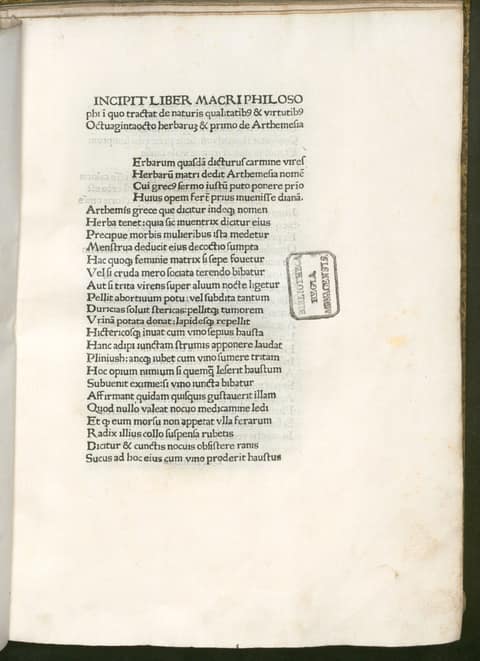
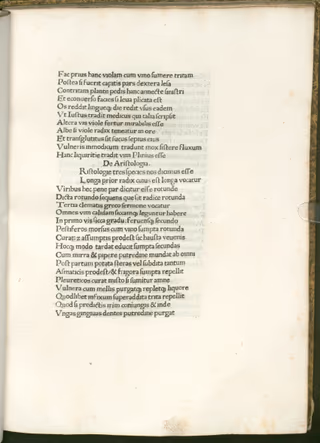
Riſtologie tres ſpecies nos dicimus eſſe
Longa prior radix cuius eſt longa vocatur
Viribus hec pene par dicitur eſſe rotunde
Dicta rotunda ſequens que ſit radice rotunda
Tertia clematis greco ſermone vocatur
Omnes vim calidam ſiccamqꝫ leguntur habere
In primo vis ſicca gradu: feruenſqꝫ ſecundo
Peſtiferos morſus cum vino ſumpta rotunda
Curat: z aſſumptis prodeſt ſic hauſta venenis
Hocqꝫ modo tardas educit ſumpta ſecundas
Cum mirra & pipere putredine mundat ab omni
Poſt partum potata ſteras vel ſubdita tantum
Aſmaticis prodeſt/ & frigora ſumpta repellit
Pleureticos curat miſto ſi ſumitur amne
Vulnera cum mellis purgatqꝫ repletqꝫ liquore
Quodlibet infixum ſuperaddita trita repellit
Quod ſi predictis irim coniungis & inde
Vngas gingiuas dentes putredine purgat
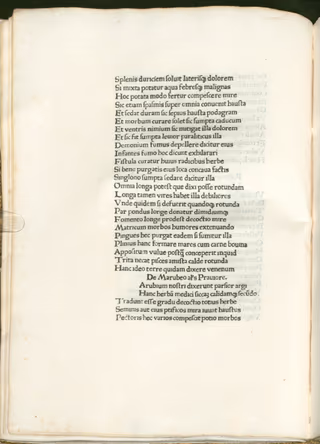
Splenis duriciem ſoluit lateriſqꝫ dolorem
Si mixta potatur aqua febreſqꝫ malignas
Hoc potata modo fertur compeſcere mire
Sic etiam ſpaſmis ſuper omnia conuenit hauſta
Et ſedat duram ſic ſepius hauſta podagram
Et morbum curare ſolet ſic ſumpta caducum
Et ventris nimium ſic mitigat illa dolorem
Et ſic fit ſumpta leuior paraliticus illa
Demonium fumus depellere dicitur eius
Infantes fumo hoc dicunt exhilarari
Fiſtula curatur huius radicibus herbe
Si bene purgatis eius loca concaua factis
Singlono ſumpta ſedare dicitur illa
Omnia longa poteſt que dixi poſſe rotundam
Longa tamen vires habet illa debiliores
Vnde quidem ſi defuerit quandoqꝫ rotunda
Par pondus longe donatur dimidiumqꝫ
Fomento longe prodeſt decoctio mire
Matricum morbos humores extenuando
Pingues hec purgat eadem ſi ſumitur illa
Plinius hanc formare mares cum carne bouina
Appoſitum vulue poſtqͣ conceperit inquid
Trita necat piſces amiſta calde rotunda
Hanc ideo terre quidam dixere venenum