Hover or tap a word to see its match.
The herb which Greek usage calls *draguntea*,
this same is called *colubrina* in the tongue of the common people,
because it rises up similar to a snake with spotted bark.
From this we believe it was discovered by the ancients
that you are able to drive away snake venom by means of a similar thing.
Whoever anoints himself with its pounded root
is said to be safe from the attack of serpents;
taken with wine, it heals their bites.
If you join oil with the juice of its seed,
pouring it into the ears, you will be able to soothe pain.
If you apply wool soaked with the juice to the nostrils,
it restrains the disease which is called a polyp.
This juice is accustomed to be a great help for cancers.
By the juice of its root, dimness is driven away,
and the various diseases which the eyes suffer,
if they are smeared with that very juice, or mixed with honey.
And the root is beneficial for the eyes if it is chewed roasted.
When thirty grains of the seed are drunk with *posca*,
they say clear vision is restored, the dimness being driven away.
If a pregnant woman draws the odor of its withering flower
into her nose, she is said to expel the aborted fetus,
or if the crushed root is placed beneath the womb.
The powder of its root, joined with honey,
restrains a cough when taken, and soothes a catarrh,
and often provides this help to those spitting blood;
it draws out the humors of the chest, so they will not return.
For all these things it is beneficial if the roasted root is taken;
its decoction will do this same thing when taken.
Its root, drunk with wine, stirs up venery;
it provokes urine, and cures phagedenic wounds
if briony is joined to it, when crushed, with honey;
this cleanses the filth of a wound and cures fistulae.
Alone, with vinegar joined to it, it drives away spots.
They say there is an affliction of the feet whose name is *parnia*;
it gets this very name from the ruin (*pernicies*) to the limbs of the sufferer;
the common people call it *mula*: this usually arises from the cold.
Boil the roots of *draguntea* in water: with such
a water the chilblain is destroyed if it is fomented often.
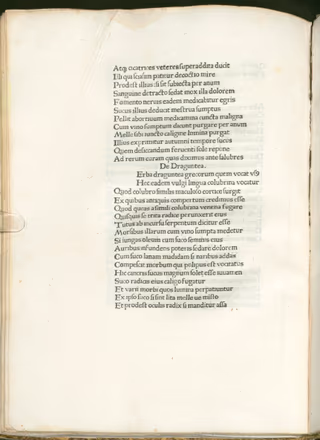
Erba draguntea grecorum quem vocat vſꝰ
Hec eadem vulgi lingua colubrina vocatur
Quod colubro ſimilis maculoſo cortice ſurgit
Ex quibus antiquis compertum credimus eſſe
Quod queas a ſimili colubrina venena fugare
Quiſquis ſe trita radice perunxerit eius
Tutus ab incurſu ſerpentum dicitur eſſe
Morſibus illarum cum vino ſumpta medetur
Si iungas oleum cum ſuco ſeminis eius
Auribus infundens poteris ſedare dolorem
Cum ſuco lanam madidam ſi naribus addas
Compeſcit morbum qui polipus eſt vocitatus
Hic cancris ſucus magnum ſolet eſſe iuuamen
Suco radicis eius caligo fugatur
Et varii morbi quos lumina perpatiuntur
Ex ipſo ſuco ſi ſint lita melle ue miſto
Et prodeſt oculis radix ſi manditur aſſa
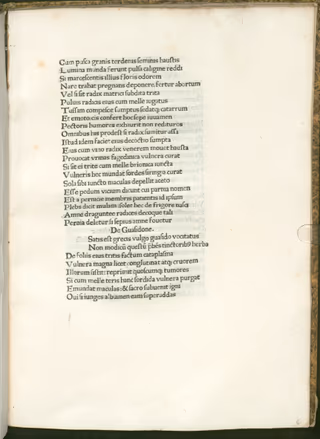
Cum puſca granis terdenis ſeminis hauſtis
Lumina munda ferunt pulſa caligine reddi
Si marceſcentis illius floris odorem
Nare trahat pregnans deponere fertur abortum
Vel ſi ſit radix matrici ſubdita trita
Puluis radicis eius cum melle iugatus
Tuſſim compeſcit ſumptus ſedatqꝫ catarrum
Et emotoicis confert hoc ſepe iuuamen
Pectoris humores exhaurit non redituros
Omnibus his prodeſt ſi radix ſumitur aſſa
Iſtud idem faciet eius decoctio ſumpta
Eius cum vino radix venerem mouet hauſta
Prouocat vrinas fagedinica vulnera curat
Si ſit ei trite cum melle brionica iuncta
Vulneris hec mundat ſordes ſiringia curat
Sola ſibi iuncto maculas depellit aceto
Eſſe pedum vicium dicunt cui parnia nomen
Eſt a pernicie membris patientis id ipſum
Plebs dicit mulam: ſolet hec de frigore naſci
Amne draguntee radices decoque tali
Pernia deletur ſi ſepius amne fouetur