Hover or tap a word to see its match.
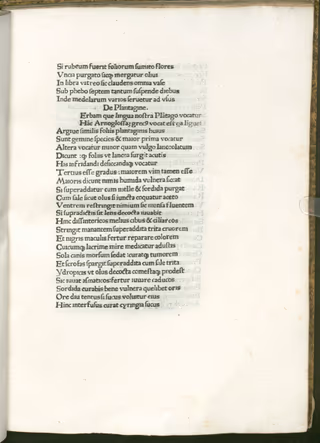
The herb which in our language is called plantain,
This the Greek calls *Arnoglossan*, because it is similar
To the Argive tongue in the leaves of this plantain.
There are twin species, and the first is called the greater,
The other is called the lesser, which commonly they call *lanceolatum*
Because it rises with sharp leaves like a lance.
Their degree of cooling and drying is said to be
The third: yet they say the greater force is
Of the greater; it dries excessively moist wounds
If it is added on top with honey, and it purges dirty ones.
If it is cooked with salt like a vegetable, joined with vinegar,
Thus chewed, it restrains an excessively flowing belly;
If lentils are cooked with the above-mentioned, it will help,
Hence as food it is better for dysenterics and celiacs.
Pounded and added on top, it stops flowing blood,
And it is reported to restore color to black spots.
With any of its sap whatsoever, it wonderfully heals burns.
Alone it soothes the bite of a dog: and it cures swelling,
And pounded with salt and added on top, it disperses scrofulas.
Cooked like a vegetable and eaten, it benefits the dropsical,
Thus it helps asthmatics: it is reported to help epileptics.
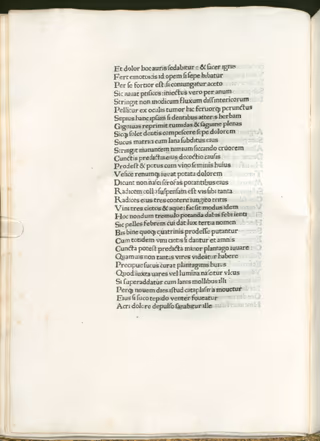
You will well cure any dirty wounds of the mouth,
If its juice, held for a long time in the mouth, is rolled around.
From this, the juice poured in cures fistulae.
And by this the pain of the ear will be soothed: and the sacred fire.
It brings aid to those spitting blood if it is drunk often.
By itself it is stronger: if it is joined with vinegar,
Thus it helps consumptives: but injected through the anus
It restrains the not inconsiderable flux of dysenterics.
This swelling and burning is driven from the eyes, when anointed.
If you chew this very herb quite often with your teeth,
It represses swollen gums and those full of blood,
And thus it is often wont to restrain the pain of a tooth.
Its juice, applied to the womb with wool,
Restrains excessively flowing blood by drying it out.
Its decoction for all the aforementioned causes
Is beneficial, and a drink of its seed with wine
Drunk, helps the pain of the bladder and kidneys.
They say scrofula does not arise for those drinking of it,
[Or with] the root suspended from the neck: its power is so great.
Crush three of its roots, join to the crushed ones
Three cyathi of wine and of water: make the measure the same.
You will give this to be drunk to a feverish person not yet trembling.
Thus you will drive away the fever to which the third day gives its name.
Twice two are also thought to benefit quartans
If they are given with as many cyathi of wine and of water.
The lesser plantain is able to help all the aforementioned things,
Although it does not seem to have such great powers.
Especially the juice of this plantain cures
An ulcer which arises near the nostrils or eyes,
If it is placed upon it with soft wool,
And for nine days that poultice is changed.
If the belly is fomented with its tepid juice,
It will be healed, with the sharp pain driven away.
Its juice is said to drive out worms.
If old pork fat is joined to it,
That poultice will soothe hard tumors.
This ointment helps parocidas and a fresh wound.
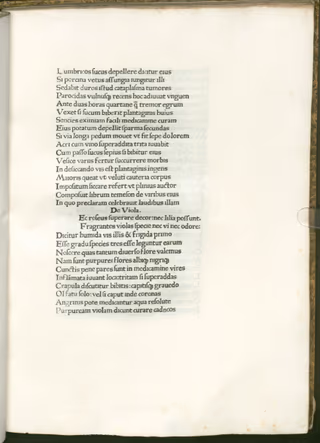
Two hours before the tremor of a quartan fever
Vexes the sick person, if he drinks the juice of this plantain,
You will perceive an excellent cure by an easy medicine.
Its seed, drunk, drives out the afterbirth.
If a long journey on foot stirs up pain, as often happens,
Crushed and applied with sharp wine, it will help.
If its juice is drunk quite often with raisin wine,
It is said to relieve various diseases of the bladder.
The drying power of plantain is immense,
Of the greater, so that it can dry the body just like cauteries
When applied, as the author Pliny relates.
Themison composed a book about its virtues,
In which he celebrated it, famous, with praises.
Erbam que lingua noſtra Plātago vocatur
Hāc Arnogloſſaꝫ grecꝰ vocat eſt ꝙa līguę
Argiue ſimilis foliis plantaginis huius
Sunt gemine ſpecies & maior prima vocatur
Altera vocatur minor quam vulgo lanceolatum
Dicunt : ꝙ foliis vt lancea ſurgit acutis
His infridandi deſiccandiqꝫ vocatur
Tertius eſſe gradus : maiorem vim tamen eſſe
Maioris dicunt nimis humida vulnera ſiccat
Si ſuperaddatur cum melle & ſordida purgat
Cum ſale ſicut olus ſi iuncta coquatur aceto
Ventrem reſtringit nimium ſic manſa fluentem
Si ſupradictis ſit lens decocta iuuabit
Hinc diſſintericos melius cibus & ciliarcos
Stringit manantem ſuperaddita trita cruorem
Et nigris maculis fertur reparare colorem
Cuicumqꝫ lacrime mire medicatur aduſtis
Sola canis morſum ſedat : curatqꝫ tumorem
Et ſcrofas ſpargit ſuperaddita cum ſale trita
Ydropicis vt olus decocta comeſtaqꝫ prodeſt
Sic iuuat aſmaticos : fertur iuuare caducos
Sordida curabis bene vulnera quelibet oris
Ore diu tentus ſi ſucus voluitur eius
Hinc interfuſus curat cyringia ſucus
Et dolor hoc auris ſedabitur : & ſacer ignis
Fert emotoicis id opem ſi ſepe bibatur
Per ſe fortior eſt : ſi coniungatur aceto
Sic iuuat ptiſicos : iniectus vero per anum
Stringit non modicum fluxum diſſintericorum
Pellitur ex oculis tumor hic feruorqꝫ perunctus
Sepius hanc ipſam ſi dentibus atteris herbam
Gigniuas reprimit tumidas & ſāguine plenas
Sicqꝫ ſolet dentis compeſcere ſepe dolorem
Sucus matrici cum lana ſubditus eius
Stringit manantem nimium ſiccando cruorem
Cunctis predictis eius decoctio cauſis
Prodeſt & potus cum vino ſeminis huius
Veſice renumqꝫ iuuat potata dolorem
Dicunt non naſci ſcrofas potantibus eius
Radicem collo ſuſpenſam eſt vis ſibi tanta
Radices eius tres contere iungito tritis
Vini tres cietos & aque : fac ſit modus idem
Hoc nondum tremulo potanda dabis febrienti
Sic pelles febrem cui dat lux tertia nomen
Bis bine quoqꝫ quatrinis prodeſſe putantur
Cum totidem vini cietis ſi dantur et amnis
Cuncta poteſt predicta minor plantago iuuare
Quamuis non tantas vires videatur habere
Precipue ſucus curat plantaginis huius
Quod iuxta nares vel lumina naſcitur vlcus
Si ſuperaddatur cum lanis mollibus illi
Perqꝫ nouem dies iſtud cataplaſma mouetur
Eius ſi ſuco tepido venter foueatur
Acri dolore depulſo ſanabitur ille
Lumbricos ſucus depellere dicitur eius
Si porcina vetus aſſungia iungitur illi
Sedabit duros iſtud cataplaſma tumores
Parocidas vulnuſqꝫ recens hoc adiuuat vnguen
Ante duas horas quartane qͣ tremor egrum
Vexet ſi ſucum biberit plantaginis huius
Sencies eximiam facili medicamine curam
Eius potatum depellit ſperma ſecundas
Si via longa pedum mouet vt fit ſepe dolorem
Acri cum vino ſuperaddita trita iuuabit
Cum paſſo ſucus ſepius ſi bibitur eius
Veſice variis fertur ſuccurrere morbis
In deſiccando vis eſt plantaginis ingens
Maioris queat vt veluti cauteria corpus
Impoſitum ſiccare refert vt plinius auctor
Compoſuit librum temeſon de viribus eius
In quo preclaram celebrauit laudibus illam