Hover or tap a word to see its match.
*Athanasia* represses the laws of death, blunts the fates,
It stops *anagoge*, vomiting, flux, diabetes,
It closes *anastomosis*, as well as *rixis* and *diabrosis*,
Flux of the womb, drippings of the throat and uvula,
And it restrains gonorrhea, binds rheums.
Dissolved in the juice of cinquefoil and nightshade, or of the blood-
herb, and also of plantain, reddened,
the blood-stone being closely rubbed with a whetstone,
smeared on both temples, and poured into the nostril,
it powerfully restrains the bloody flow from the nostril. —
This same thing given with the juice of plantain wards off
the bloody flux, which the nutritive parts loosen;
When, through anatropa, the prison of the veins having been broken,
The blood seeks the highest parts, moved by the sharpness of heat,
Flowing from the lung, or from the liver, or bursting forth
From the region of the chest, or when diabrosis draws it
Out from the veins; *Athanasia* mixed with the liquor,
Which crushed knotgrass or chicory produces,
Drunk, is able to restrain the bloody flux.
But because a vehement constriction of the lung incites
A cough, and opens the veins, and more strongly sharpens
The flow of blood, you will give this antidote more prudently
To the patient, if you give to drink the lenitives:
*Penidia*, starch, *ptisana*, gum, *dragagantum*:
When lenitives are given first, and the latter follow,
The constrictive virtue draws moderation from them,
So that it does not now have to presume other movements,
But content with its own, it protects itself by its own law.
It does not open the veins, nor relax them by an intervening cough,
Nor does it contribute to the flux which its own nature restrains. —
When blood flows out from the bottom by a defect
Of the intestines, this, transmitted downwards with a clyster,
Restrains the flux, dissolved in the former juice.
To which if bole and dragon's blood are mixed,
Gall, roses, bramble, balaustine, pomegranate rind, mastic,
*Mintua*, root of comfrey, egg white, vinegar:
You will make from these a useful poultice, which
Applied from above to the sick members will be able
More completely to finish the whole cure of the bloody flux.
It constrains the menses, which the furious force of heat
Stirs up, if it is drunk mixed with plantain,
Or the womb is fomented with water, in which broom is cooked,
With which *Athanasia* is mixed by the weight of a pound,
Restricted by a certain moderation to a sixth part.
If abundant blood makes the menses flow
When it overflows too much, unable to be held in the vessel:
*Athanasia* cannot restrain such a flux,
Which the celebrated bloodletting from the saphenous veins settles. —
A woman, whose womb, full of windy vapor,
Constrains the vital organs, with the stomach compressed,
So that, with the freedom of breathing now lost,
Syncope arises and suffocation occurs:
Let her fumigate her nostrils with this medicine placed on glowing coals,
So that the smoke, striking the nerves of the drawn womb with the odor,
May force it to decline to a lower place
And be held in its proper seat:
Let it not be poured into the vulva, nor placed underneath,
Nor let its smoky cloud steam the womb:
From this its nature, badly saddened,
Fleeing the horror of the vapor, disturbed by the sad flavor,
Seeking the heights more strongly, with the right of its station abandoned,
Would burden the vital organs with stable pressure.
It places reins on gonorrhea, which a slippery humor
And one softening the vessels generates, or watery semen
Or a weak retentive force, unable to contain
What must be retained, applied to the genital organs
With castoreum mixed into it along with powder of myrrh,
Or with the juice of an herb, which a styptic virtue makes favorable
To the disease, or let it be drunk with rustic wine
And sufficiently austere, to which bdellium, and castoreum,
Mastic with myrrh, having been decocted, have given vigor.
Drunk with rosy or heavenly liquid
It excludes tipsicon, which, although it is born of heat,
Is painted with a white face as an interpreter of cold
And causes physicians to err, for the discolored
Appearance of its urine clouds over the origin of the cause.
To this houseleek, rose, sandalwood and nightshade,
Plantain, blackberry, equally associated of a fitting
Let them enter the bonds of mixture, so that the dry ingredients
Commit fine ashes to the mixture and the juicy ones juices.
Such a preparation tempers the flux of urine,
When added in the form of a plaster to heated limbs.
A sheet of lead pierced with many a hole,
Fitted to the loins smeared with rose oil:
Is accustomed to provide no small relief to this affliction.
Drunk with pure wine of mastic, or with the juice of briar
Shoots, this same medicine is said to provide a healthful
Cure for coeliacs, whom an abundant hot humor
Troubles with a flux of the belly and excessive pain. —
It cures those vexed by colics from hot rheum,
If it is first dissolved in water of infused tragacanth.
If the colic disease is from viscous rheum,
Such a medicine achieves no efficacy. —
Given in pills made with the powder of bole,
Mastic, and the herb, to which consolidation provides
The name of *consolida*, it medicates dysenterics,
Whom a tearing of the uppermost intestine troubles,
Or the anagallic root may be boiled, the liquor of which
This medicine, when drunk, may mix with itself.
If the root of dysentery is founded in the lowest
Bowels, dissolved in ptisan and the said liquor,
This same medicine, given as a clyster, will help not a little.
Art commands and the skilled doctrine of healing demands,
That a purgation with yellow myrobalans
Should precede, cleansing the harmful humors from the body. —
Which, given with rose water or water born from the clouds,
In which pomegranates have cooked their flowers,
Restrains the raw drippings of lienteric flux,
For which a slippery and smooth humor provides the cause,
Of which the celebrated *Metridatus* is believed to be a more special,
And also a more trustworthy, cure.
The faithful medicine of the antidote ought to precede the path
Of lientery, which long ago a long
And old experience has made it proper for the disease.
But if by chance you should ask, what the material of this medicine is,
myrobalans give it chebules,
the fir gives fungus, the oak fern, the colocynth pulp,
the fennel fennel-seed; use and practice bestow upon you
the form of compounding, and render you a master.
A scar or an abscess born from dysentery, gnawing the villi,
brings about the cause of lientery,
which is helped by no art of the said medicine!
Before the height, near the beginnings of the rheumatic motion,
it heals an abscess that possesses the interior of the body,
if it is given with infused tragacanth:
It represses one born on the outside, and restrains the flux,
applied to the injured member in the form of a poultice,
dissolved with the juice of houseleek, or with that
which knotweed, distinguished by a hundred knots, produces.
If the same is given in pills with frankincense mixed in,
it suspends the rheum of a future abscess:
it purges the defect of a past one with powder of myrrh.
Taken with a little liquor of honey and oil
it destroys the harms of internally taken poison:
With the honey it washes, strains, wipes away, cleanses noxious things,
from the oil it provokes vomiting, and purges by vomiting,
and by its own force it fortifies the vital members.
Mixing to this gentian and birthwort,
also the broth of dittany, if you give this to the patient
late after vomiting, not for making a vomit,
you remove its powers from the internally taken poison.
For from the remains, the force of the antidote consumes the venom,
which perhaps has stuck to the bowels, and utterly absorbs it,
having obtained from this double vigor.
This mixture helps when added over the injured members,
which draw the harsh contagions of a viper's venom.
It comes to the aid of afflicted teeth, eyes, and headache,
And of tears, fashioned in a similar tenor,
Which it holds in similar cases when *Aurea* is given. —
It cures oppressed ears, weighed down by excessive pain,
When instilled with the juice of houseleek. —
With figs, raisins, and sweet Calenian wine
Let him gargle it, who has a throat constricted
By cold rheum, and swollen, and exceedingly painful:
From which things it will help for a prepared poultice to be applied. —
For stomach sufferers, whose digestion the cold deranges,
It is beneficial when drunk with mastic wine.
This method, this use, this law, this form of healing
Kept a celebrated course in ancient time;
For then *Athanasia*, consisting of hot ingredients,
Could constantly counter cold causes.
Since cold things now predominate with hot things in it,
Moderns shun and reject this curative use. —
A poultice made from this, mixed equally together with mastic, costus,
Olibanum, and melted wax,
Applied to the stomach checks catatropa and breaks
The loosened reins of an enormous vomit. —
Its final limit is the third year. —
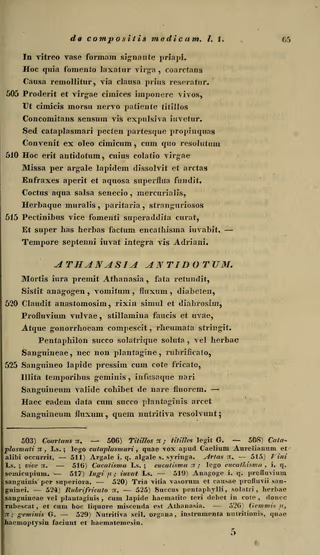
Mortis iura premit Athanasia, fata retundit,
Sistit anagogen, vomitum, fluxum, diabeten,
Claudit anastomosim, rixin simul et diabrosim,
Profluvium vulvae, stillamina faucis et uvae,
Atque gonorrhoeam compescit, rheumata stringit.
Pentaphilon succo solatrique soluta, vel herbae
Sanguineae, nec non plantagine, rubrificato,
Sanguineo lapide pressim cum cote fricato,
Illita temporibus geminis, infusaque nari
Sanguineum valide cohibet de nare fluorem. —
Haec eadem data cum succo plantaginis arcet
Sanguineum fluxum, quem nutritiva resolvunt;
Cum per anatropam, venarum carcere rupto,
Summa petit sanguis fervoris acumine motus,
De pulmone fluens, vel ab hepate, vel regione
Pectoris erumpens, vel cum diabrosis eundem
Elicit a venis; Athanasia mixta liquori,
Quem contrita facit polygonia vel cicorea,
Sanguineum potata valet compescere fluxum.
Sed quia pulmonis vehemens constrictio tussim
Incitat, et venas aperit, fluxumque cruoris
Fortius exacuit, consultius hoc patienti
Antidotum dederis, si lenitiva propines
Penidias, amylum, ptisanam, gummi, dragagantum:
Lenia cum dantur prius, et postrema sequuntur,
Constrictiva trahit virtus moderamen ab illis,
Ut iam non alios habeat praesumere motus,
Sed contenta suis propria se lege tuetur.
Non aperit venas, media nec tusse resolvit,
Nec facit ad fluxum sua quem natura coërcet. —
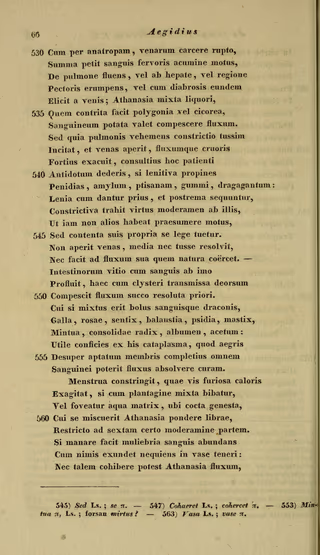
Intestinorum vitio cum sanguis ab imo
Profluit, haec cum clysteri transmissa deorsum
Compescit fluxum succo resoluta priori.
Cui si mixtus erit bolus sanguisque draconis,
Galla, rosae, sentix, balaustia, psidia, mastix,
Mintua, consolidae radix, albumen, acetum:
Utile conficies ex his cataplasma, quod aegris
Desuper aptatum membris completius omnem
Sanguinei poterit fluxus absolvere curam.
Menstrua constringit, quae vis furiosa caloris
Exagitat, si cum plantagine mixta bibatur,
Vel foveatur aqua matrix, ubi cocta genesta,
Cui se miscuerit Athanasia pondere librae,
Restricto ad sextam certo moderamine partem.
Si manare facit muliebria sanguis abundans
Cum nimis exundet nequiens in vase teneri:
Nec talem cohibere potest Athanasia fluxum,
Quem de saphenis celebrata minutio sedat. —
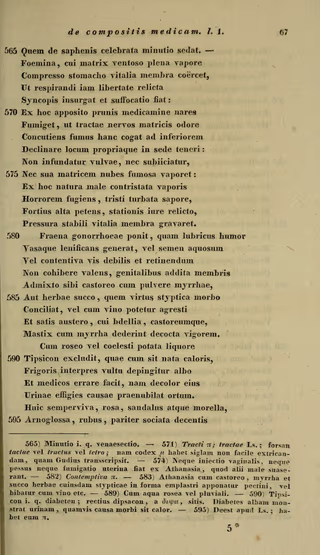
Foemina, cui matrix ventoso plena vapore
Compresso stomacho vitalia membra coërcet,
Ut respirandi iam libertate relicta
Syncopis insurgat et suffocatio fiat:
Ex hoc apposito prunis medicamine nares
Fumiget, ut tractae nervos matricis odore
Concutiens fumus hanc cogat ad inferiorem
Declinare locum propriaque in sede teneri:
Non infundatur vulvae, nec subiiciatur,
Nec sua matricem nubes fumosa vaporet:
Ex hoc natura male contristata vaporis
Horrorem fugiens, tristi turbata sapore,
Fortius alta petens, stationis iure relicto,
Pressura stabili vitalia membra gravaret.
Fraena gonorrhoeae ponit, quam lubricus humor
Vasaque lenificans generat, vel semen aquosum
Vel contentiva vis debilis et retinendum
Non cohibere valens, genitalibus addita membris
Admixto sibi castoreo cum pulvere myrrhae,
Aut herbae succo, quem virtus styptica morbo
Conciliat, vel cum vino potetur agresti
Et satis austero, cui bdellia, castoreumque,
Mastix cum myrrha dederint decocta vigorem.
Cum roseo vel coelesti potata liquore
Tipsicon excludit, quae cum sit nata caloris,
Frigoris interpres vultu depingitur albo
Et medicos errare facit, nam decolor eius
Urinae effigies causae praenubilat ortum.
Huic semperviva, rosa, sandalus atque morella,
Arnoglossa, rubus, pariter sociata decentis
Foedera mixturae subeant, ut sicca minutos
Mixturae mandent cineres et succida succos.
Temperat urinae fluxum confectio talis,
Sub forma emplastri calefactis addita membris.
Lamina de plumbo distincta foramine multo,
Ex oleo roseo lumbis aptata perunctis:
Haud modicum solet huic causae praestare iuvamen.
Masticis hausto mero, vel cum succo turionum
Senticis, haec eadem fertur praestare salubrem
Coeliacis curam, calidus quos humor abundans
Profluvio ventris, nimioque dolore molestat. —
De calido colicos vexatos rheumate curat,
Si prius infusi solvatur aqua dragaganti.
Si colicus de viscoso sit rheumate morbus,
Consequitur nullum talis medicina vigorem. —
In pilulis data confectis cum pulvere boli,
Masticis, ac herbae, cui consolidatio nomen
Praebet consolidae, dysentericis medicatur,
Quos intestini vexat scissura supremi,
Aut elixetur radix anagallica, cuius
Misceat haec medicina sibi potata liquorem.
Si dysenteriae radix fundetur in imis
Visceribus, ptisana, dictoque liquore soluta,
Haec eadem haud modicum clysterizata iuvabit.
Ars iubet et sollers poscit doctrina medendi,
Quod cum citrinis purgatio myrobalanis
Praeveniat, nocuos mundans a corpore chymos. —
Quae data cum rosea vel aqua de nubibus orta,
In qua mala suos coxerunt Punica flores,
Cruda lienterici cohibet stillamina fluxus,
Lubricus et lenis cui causam suggerit humor,
Cuius Metridatus celebris magis et specialis,
Plus quoque digna fide curatio creditur esse.
Antidoti medicina viam praecurrere debet
Fida lienteriae, quam dudum longa probavit,
Et morbi propriam vetus experientia fecit.
Quodsi forte roges, quae sit medicaminis huius
Materies, illi kebulos dant myrobalani,
Fungum abies, filicem quercus, coloquinthida pulpam,
Feniculus marathrum; tibi formam conficiendi
Usus et officium tribuit, redditque magistrum.
Ex dysenteria, villos rodiente, cicatrix
Nata lienteriae causam vel apostasis infert,
Quae nulla dicti medicaminis arte iuvatur!
Ante statum, prope rheumatici primordia motus,
Sanat apostema, quod corporis interiora
Possidet, infuso si sit data cum dragaganto:
Exterius natum reprimit, fluxumque coërcet,
Laeso sub specie cataplasmatis addita membro,
Cum sempervivae succo resoluta, vel illo,
Quem distincta facit centum polygonia nodis.
In pilulis eadem si commixto sibi thure
Detur, apostaseos suspendit rheuma futurae:
Purgat praeteritae vitium cum pulvere myrrhae.
Cum modico mellis oleique recepta liquore
Interius sumti delet nocumenta veneni:
Melle lavat, colat, detergit, noxia mundat,
Provocat ex oleo vomitum, purgatque vomendo,
Ipsaque vi propria munit vitalia membra.
Cui gentianam miscens et aristolochiam
Jus quoque diptamni, si post vomitum patienti
Hanc dederis sero non pro vomitu faciendo,
Interius sumto demis sua iura veneno.
Nam de reliquiis virus, quod forsan inhaesit
Visceribus, vis antidoti consumit et ipsum
Absorbet penitus, ex hoc bis nacta vigorem.
Haec mixtura iuvat laesis superaddita membris,
Viperei quae dura trahunt contagia virus.
Dentibus afflictis, oculis, capitisque dolori,
Subvenit, et lacrymis simili formata tenore,
Quem tenet in paribus quando datur *Aurea* causis. —
Auribus oppressis, nimioque dolore gravatis,
Cum sempervivae succo instillata medetur. —
Cum caricis, uvis passis, dulcique caleno
Gargarizet eam, gelido qui rheumate fauces
Compressas habet, et tumidas, nimiumque dolentes:
Ex quibus apponi factum cataplasma iuvabit. —
Stomaticis, quorum pexim distemperat algor,
Cum masticino confert potata Lyaeo.
Hîc modus, hic usus, haec lex, haec forma medendi
Antiquo celebrem servavit tempore cursum;
Nam tunc ex calidis constans *Athanasia* rebus
Constanter poterat gelidis occurrere causis.
Frigida cum calidis nunc praedominentur in illa,
Hunc curandi usum fugiunt reprobantque moderni. —
Ex hac commixtis pariter sibi mastice, costo,
Olibano, cera, factum cataplasma soluto
Appositum stomacho catatropam fraenat et ipsum
Enormis vomitus laxatas frangit habenas. —
Terminus est eius finalis tertius annus. —