Hover or tap a word to see its match.
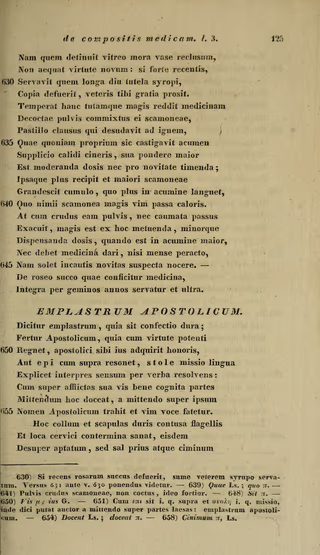
It is called a plaster, because it is a hard confection;
It is said to be Apostolic, because since with potent virtue
It reigns, it acquires for itself the right of apostolic honor,
Or since *epi* sounds as "above", and *stole* as "sending" in the language,
An interpreter may explain the meaning, resolving it through the words:
Since its well-known power teaches that this is to be sent
Upon the afflicted parts, from sending upon it
It draws the Apostolic name and confesses its power by its word.
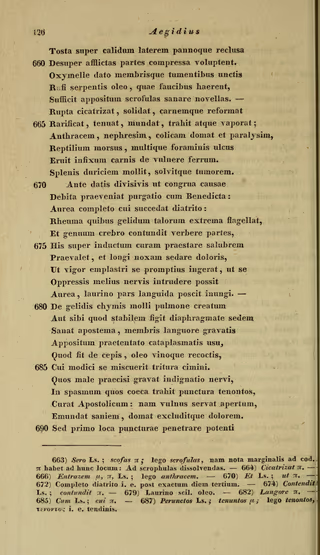
This heals the neck and shoulders bruised by hard whips
And the places adjoining the neck, when fitted
Upon them, but first salt and cumin
Roasted over a hot brick and enclosed in a cloth,
pressed from above upon the afflicted parts, let them soothe them.
With oxymel given and the swelling limbs anointed
with the oil of a red snake, applied it is sufficient
to cure early scrofulae which cling to the throat. --
It scars over what is broken, makes it solid, and restores the flesh,
It rarefies, thins, cleanses, draws, and vaporizes;
It overcomes anthrax, nephritis, colic, and paralysis,
the bites of reptiles, and an ulcer with many holes,
It roots out an embedded iron from a wound in the flesh.
It softens the hardness of the spleen, and resolves its tumor.
With divisive medicines given beforehand, so that a due
purgation suitable for the cause may precede with Benedicta:
to which Aurea should succeed after a diatritos is completed:
For those whom a cold rheum whips the extremities of their ankles,
and bruises the parts of the knees with frequent lashing,
drawn over these, it prevails to provide a healing cure,
and to settle the harm of long pain,
So that the vigor of the plaster may introduce itself more promptly, so that
Aurea can better thrust itself into the oppressed nerves,
the languid part demands to be anointed with laurel oil. --
Created from cold humors in the soft lung,
or that which fixes a stable seat for itself in the diaphragm,
it cures the apostema, applied to limbs weighed down by languor,
with the use of a cataplasm having been tried beforehand,
which is made from onions, re-cooked in oil and wine,
to which a grinding of a little cumin has mixed itself.
Those whom the indignation of a badly severed nerve burdens,
Those whom the blind puncture of a tendon draws into a spasm,
the Apostolicum cures: for it keeps the wound open,
It cleanses out the sanies, subdues and shuts out the pain.
But first, to penetrate the places of the puncture with a potent
It will be expedient to drench it with terebinthine resin.
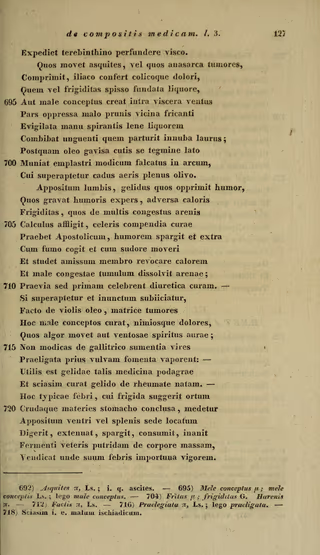
It reduces the swellings which ascites provokes, or which anasarca [provokes],
it is beneficial for iliac and colic pain,
which either coldness based upon thick fluid,
or ill-conceived wind creates within the bowels.
Let the part oppressed by the ailment, near burning coals,
awakened by a rubbing hand, drink in the fluid
of the gently fragrant ointment which the maiden laurel brings forth;
after the skin, rejoicing in the oil, fortifies itself with a broad covering
of the plaster, curved slightly into a bow,
let a bronze vessel full of olive oil be fitted over it.
Applied to the loins, which a cold humor oppresses,
which a coldness devoid of humor, hostile to heat,
burdens, which the stone, accumulated from much sand,
afflicts, the Apostolicum provides the shortcuts to a swift cure;
it disperses the humor and compels it to be moved
outwards with vapor and with sweat,
and it strives to restore the lost heat to the limb,
and it dissolves the mound of badly congested sand;
but let previous diuretics perform the first cure. —
If it is applied on top and placed underneath, anointed
with oil made from violets, it cures ill-conceived
swellings in the womb, and excessive pains,
which cold or the breath of a windy breeze provokes;
let fomentations, taking no small strength from clary sage,
bound on beforehand, steam the vulva: —
Such a medicine is useful for cold gout,
and it cures sciatica born from a cold rheum. —
This heals a typical fever, for which a cold
and raw matter enclosed in the stomach supplies the origin;
applied to the belly or placed in the seat of the spleen,
it digests, thins out, scatters, consumes, [and] empties
the putrid mass of old ferment from the body,
from whence the troublesome fever claims its vigor.
Wounds feeding broadly on corrupted flesh,
whose shape a fistula delineates, distinguished by a manifold opening,
and marks with the same name,
the Apostolicum heals: it draws out pus and cleanses the sites;
the mouths from which infected blood emerges, and from which noxious humor
breaks forth, through which the substance of the limb
is sickened, these it unseals and loosens all barriers;
let a tent formed from green cyclamen,
made equal to the corrupted spots, first probe the openings of the ulcer,
and afterward the plaster, well-softened, clinging firmly to the membrane,
desires to join itself to the flawed limb. —
The bite that a rabid dog or a viper has inflicted,
and whatever wounds, exceedingly suspected of pestiferous poison,
set in motion the hazards of sudden death,
the Apostolicum heals, but first the lesion needs to be washed
with the juice of mint mixed with *Tiriaca*.
The Ceroticum retains a similar vigor in all respects,
the Oxyrocrocinum conspires toward a similar effect,
and the *Diateraseos* claims equal effects for itself. —
In a lustral period it flourishes with special virtue.
Dicitur emplastrum, quia sit confectio dura;
Fertur Apostolicum, quia cum virtute potenti
Regnet, apostolici sibi ius adquirit honoris,
Aut *epi* cum supra resonet, *stole* missio lingua
Explicet interpres sensum per verba resolvens:
Cum super afflictas sua vis bene cognita partes
Mittendum hoc doceat, a mittendo super ipsum
Nomen Apostolicum trahit et vim voce fatetur.
Hoc collum et scapulas duris contusa flagellis
Et loca cervici contermina sanat, eisdem
Desuper aptatum, sed sal prius atque ciminum
Tosta super calidum laterem pannoque reclusa
Desuper afflictas partes compressa voluptent.
Oxymelle dato membrisque tumentibus unctis
Rufi serpentis oleo, quae faucibus haerent,
Sufficit appositum scrofulas sanare novellas. --
Rupta cicatrizat, solidat, carnemque reformat
Rarificat, tenuat, mundat, trahit atque vaporat;
Anthracem, nephresim, colicam domat et paralysim,
Reptilium morsus, multique foraminis ulcus
Eruit infixum carnis de vulnere ferrum.
Splenis duriciem mollit, solvitque tumorem.
Ante datis divisivis ut congrua causae
Debita praeveniat purgatio cum *Benedicta*:
*Aurea* completo cui succedat diatrito:
Rheuma quibus gelidum talorum extrema flagellat,
Et genuum crebro contundit verbere partes,
His super inductum curam praestare salubrem
Praevalet, et longi noxam sedare doloris,
Ut vigor emplastri se promptius ingerat, ut se
Oppressis melius nervis intrudere possit
*Aurea*, laurino pars languida poscit inungi. --
De gelidis chymis molli pulmone creatum
Aut sibi quod stabilem figit diaphragmate sedem
Sanat apostema, membris languore gravatis
Appositum praetentato cataplasmatis usu,
Quod fit de cepis, oleo vinoque recoctis,
Cui modici se miscuerit tritura cimini.
Quos male praecisi gravat indignatio nervi,
In spasmum quos coeca trahit punctura tenontos,
Curat Apostolicum: nam vulnus servat apertum,
Emundat saniem, domat excluditque dolorem.
Sed primo loca puncturae penetrare potenti
Expediet terebinthino perfundere visco.
Quos movet asquites, vel quos anasarca tumores,
Comprimit, iliaco confert colicoque dolori,
Quem vel frigiditas spisso fundata liquore,
Aut male conceptus creat intra viscera ventus
Pars oppressa malo prunis vicina fricanti
Evigilata manu spirantis lene liquorem
Combibat unguenti quem parturit innuba laurus;
Postquam oleo gavisa cutis se tegmine lato
Muniat emplastri modicum falcatus in arcum,
Cui superaptetur cadus aeris plenus olivo.
Appositum lumbis, gelidus quos opprimit humor,
Quos gravat humoris expers, adversa caloris
Frigiditas, quos de multis congestus arenis
Calculus affligit, celeris compendia curae
Praebet Apostolicum, humorem spargit et extra
Cum fumo cogit et cum sudore moveri
Et studet amissum membro revocare calorem
Et male congestae tumulum dissolvit arenae;
Praevia sed primam celebrent diuretica curam. —
Si superaptetur et inunctum subiiciatur,
Facto de violis oleo, matrice tumores
Hoc male conceptos curat, nimiosque dolores,
Quos algor movet aut ventosae spiritus aurae;
Non modicas de gallitrico sumentia vires
Praeligata prius vulvam fomenta vaporent: —
Utilis est gelidae talis medicina podagrae
Et sciasim curat gelido de rheumate natam. —
Hoc typicae febri, cui frigida suggerit ortum
Crudaque materies stomacho conclusa, medetur
Appositum ventri vel splenis sede locatum
Digerit, extenuat, spargit, consumit, inanit
Fermenti veteris putridam de corpore massam,
Vendicat unde suum febris importuna vigorem.
Vulnera corruptas late pascentia carnes,
Quorum multiplici distincta foramine formam
Fistula describit et eodem nomine signat,
Sanat Apostolicum: pus attrahit et loca mundat,
Ora quibus sanies emergitur, et quibus humor
Noxius erumpit, per quam substantia membri
Nauseat, haec reserat et cuncta repagula solvit,
Corruptis aequata locis prius ostia tentet
Ulceris ex viridi formata cyclamine tenta,
Post bene mollitum membranae firmiter haerens
Se cupit emplastrum vitiato iungere membro. —
Quem canis impressit rabidus vel vipera morsum,
Et subiti quaecumque movent discrimina fati
Vulnera pestifero nimium suspecta veneno,
Sanat Apostolicum, sed primum plaga lavari
Indiget ex succo menthae mixto Tiriacae
Ceroticum similem retinet per cuncta vigorem,
Oxyrocrocinum similem coniurat in actum,
Et Diateraseos actus sibi vendicat aequos. —
Tempore lustrali virtute viget speciali.