Hover or tap a word to see its match.
*Haemagogum* has drawn its proper name from blood,
Because it pertains especially to women's conditions:
And what a long injury to the womb has denied,
When the veins are closed by cold with viscous blood,
It moves and compels the bloody tribute to flow,
It destroys the creature of the womb and expels it destroyed.
For those who cannot be well purged after the times of childbirth,
It purifies the menses, and cuts away all harmful things,
And loosens the previously constricted reins of the womb.
Drunk, it moves urine, dissolves sand,
Heals strangury, dissolves fragments of stone,
Unlocks enphraxis of the liver, and attenuates tumor of the spleen,
Heals colics from coldness:
It tames the chest compressed by cold chymes;
It cures bowels beaten by windy storms;
It overturns vomiting: the accepted foods which the nausea of a raw stomach
Rejects, *Haemagogum* retains:
It moves the phlegmatic humor, and powerfully
Casts out the moved [humor]. In women's conditions, use proves no medicine
Stronger and better than this.
By those suffering from and weakened by hemorrhoids,
This antidote must be avoided with the utmost reason. —
The whole power of *Haemagogum* remains for four years.
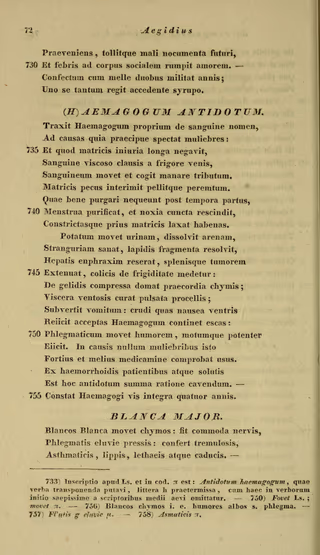
Traxit Haemagogum proprium de sanguine nomen,
Ad causas quia praecipue spectat muliebres:
Et quod matricis iniuria longa negavit,
Sanguine viscoso clausis a frigore venis,
Sanguineum movet et cogit manare tributum,
Matricis fetus interimit pellitque peremtum.
Quae bene purgari nequeunt post tempora partus,
Menstrua purificat, et noxia cuncta rescindit,
Constrictasque prius matricis laxat habenas.
Potatum movet urinam, dissolvit arenam,
Stranguriam sanat, lapidis fragmenta resolvit,
Hepatis enphraxim reserat, splenisque tumorem
Extenuat, colicis de frigiditate medetur:
De gelidis compressa domat praecordia chymis;
Viscera ventosis curat pulsata procellis;
Subvertit vomitum: crudi quas nausea ventris
Reiicit acceptas Haemagogum continet escas:
Phlegmaticum movet humorem, motumque potenter
Eiicit. In causis nullum muliebribus isto
Fortius et melius medicamine comprobat usus.
Ex haemorrhoidis patientibus atque solutis
Est hoc antidotum summa ratione cavendum. —
Constat Haemagogi vis integra quatuor annis.