Hover or tap a word to see its match.
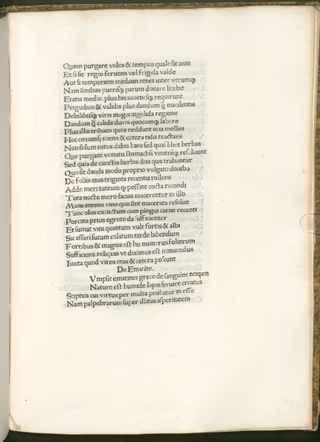
Hematite took its name from the Greek for blood.
It is a stone created to serve human nature,
In which a styptic power is proven to be present through many things.
For, smeared upon the roughness of the eyelids,
And, with the darkness driven away, it clears dim sight,
If the glair of an egg is mixed with a fragment of it,
Diluted with the juice which pomegranates yield,
On a medical whetstone, just as for eye-salves.
Or dissolved in water, it helps those who emit froths
Of blood from the mouth: and it heals any ulcers.
Drunk, it binds the flow which a woman suffers.
The power of this powder represses flesh growing
In a wound: and it retains a flowing belly without delay.
And diluted with old wine and drunk frequently,
It excellently cures the bite of a serpent: or the wound
Which is from an asp, when anointed and dissolved in waters.
Mixed with honey, it can heal aching eyes.
Drunk, it is said to dissolve stones of the bladder.
This is marked by a rust-like or red color.
Africa sends it, or the Ethiopians and Arabs.
The land of Arcadia produces the stone ebestes.
A burning heat belongs to it, a wondrous power of nature,
Reflecting the labors of the female sex by undergoing change.
For from what causes is doubtful: but at a fixed time
It conceives: and gives birth and helps mothers
Whom the final hour of perilous crisis presses upon.
Take Satyrion, bird's tongue, and Mercury,
Take pimpernel and grind it with honeysuckle,
Take juice of chervil and argentilla,
And just as much of honey and give to the patient to drink.
Svmpſit ematites greco de ſanguine nomen
Nature eſt humide lapis ſeruire creatus
Stiptica cui virtus per multa probatur in eſſe
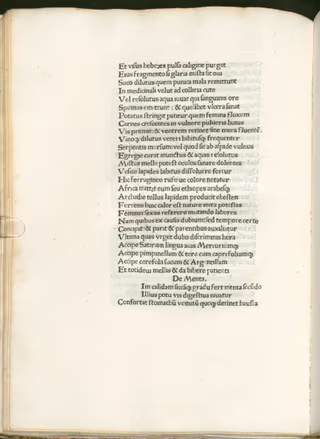
Nam palpebrarum ſuper illitus aſperitatem
Et viſus hebetes pulſa caligine purgat
Eius fragmento ſi glaria miſta ſit oui
Suco dilutus quem punica mala remittunt
In medicinali velut ad colliria cute
Vel reſolutus aqua iuuat qui ſanguinis ore
Spumas emittunt: & quelibet vlcera ſanat
Potatus ſtringit patitur quem femina fluxum
Carnes creſcentes in vulnere pulueris huius
Vis premit: & ventrem retinet ſine mora fluentē.
Vinoꝙ dilutus veteri bibituſqꝫ frequenter
Serpentis morſum: vel quod ſit ab aſpide vulnus
Egregie curat inunctus & aquis reſolutus
Miſtus melle poteſt oculos ſanare dolentes
Veſice lapides bibitus diſſoluere fertur
Hic ferrugineo rufo ue colore notatur
Africa mittit eum ſeu ethiopes arabeſqꝫ
Archadie tellus lapidem producit ebeſten
Feruens huic calor eſt nature mira poteſtas
Feminei ſexus referens mutando labores
Nam quibus ex cauſis dubium: ſed tempore certo
Concipit: & parit & parentibus auxiliatur
Vltima quas vrget dubii diſcriminis hora
Accipe Satirion lingua auis Mercuriumqꝫ
Accipe pimpinellam & tere cum capri foliumqꝫ
Accipe cerefolii ſucum & Argentillam
Et totidem mellis & da bibere patienti
