Hover or tap a word to see its match.
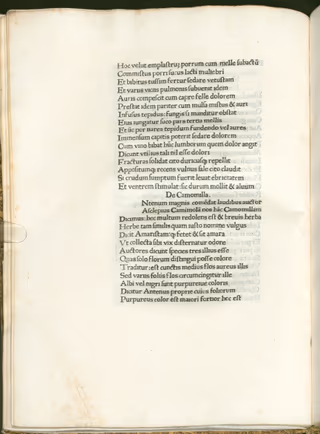
Antenum the authority commends with great praises,
Asclepius, Camimola; we this Camomilla
Call: this is a very fragrant and short plant
So similar to the plant which the common people by a just name
Call Amarista: because it stinks and is bitter
That gathered together it is scarcely distinguished by smell.
Authors say that there are three species of it
Which can be distinguished only by the color of the flowers,
It is handed down: the middle flower in all of them is golden
But that flower is surrounded by varying leaves
They are of white or black or purple color.
It is properly called Antenus whose leaves'
Color is purple; this is stronger to a greater degree.
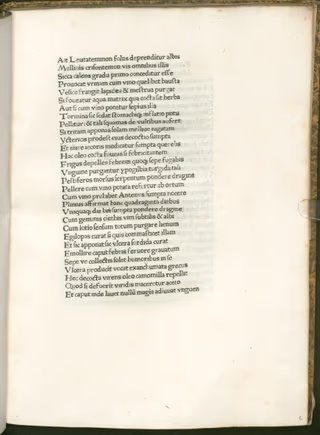
He says *Leutateminon* is distinguished by white leaves,
yellow *crisontemon*. The power in all of them
is conceded to be dry and hot in the first degree.
Any of them, drunk with wine, provokes urine,
breaks stones of the bladder and purges menses,
if the womb is fomented with water in which the herb has been cooked,
or if it is drunk more often with wine;
thus it calms colic, and inflation of the stomach
is driven away by the drink: and by such it removes scales from faces,
if you apply it ground, alone or joined with honey.
Its decoction, taken, benefits the jaundiced,
and, taken, marvelously medicates complaints of the liver.
If you foment a feverish person with this cooked in oil,
you will drive away the chill, and you will also often put the fever to flight.
Swollen *ypogilbia* are purged by such an ointment.
Pestiferous bites of serpents, in the weight of a drachma,
drunk with wine, it is reported to drive away, and an abortion.
Antenus states that, taken with wine, it prevents harm.
Pliny affirms that this herb, for forty days,
taken twice on each day in the weight of a drachma,
with twin *cyathi* of subtle and white wine,
purges the entire feeling of the spleens with urine.
It cures *egilopas* if someone chews it,
and applies it thus; thus it cures foul ulcers.
To soften a head weighed down by the heat of a fever,
or often, by humors collected in itself,
it produces ulcers the Greek calls *exanchumata*;
this green chamomile, boiled in oil, repels them.
But if the green is lacking, let it be macerated in vinegar,
and let him wash the head with it; no ointment helps more.
Ntenum magnis comēdat laudibus auctor
Aſclepius Camimolā nos hāc Camomillam
Dicimus: hec multum redolens eſt & breuis herba
Herbe tam ſimilis quam iuſto nomine vulgus
Dicit Amariſtam: ꝙ fetet & ſit amara
Vt collecta ſibi vix diſternatur odore
Auctores dicunt ſpecies tres illius eſſe
Quas ſolo florum diſtingui poſſe colore
Traditur: eſt cunctis medius flos aureus illis
Sed variis foliis flos circumcingitur ille
Albi vel nigri ſunt purpureiue coloris
Dicitur Antenus proprie cuius foliorum
Purpureus color eſt maiori fortior hec eſt
Ait Leutateminon foliis deprenditur albis
Mellinis criſontemon vis omnibus illis
Sicca calens gradu primo conceditur eſſe
Prouocat vrinam cum vino quelibet hauſta
Veſice frangit lapides & meſtrua purgat
Si foueatur aqua matrix qua cocta ſit herba
Aut ſi cum vino potetur ſepius illa
Tormina ſic ſedat ſtomachiqꝫ inflatio potu
Pellitur: & tali ſquamas de vultibus aufert
Si tritam apponas ſolam melliue iugatam
Yctericis prodeſt eius decoctio ſumpta
Et mire iecoris medicatur ſumpta querelis
Hac oleo cocta foueas ſi febricitantem
Frigus depelles febrem quoqꝫ ſepe fugabis
Vnguine purgantur ypogilbia turgida tali
Peſtiferos morſus ſerpentum pondere dragme
Pellere cum vino potata refertur abortum
Cum vino prehibet Antenus ſumpta nocere
Plinius affirmat hanc quadraginta diebus
Vnaquaqꝫ die bis ſumpta pondere dragme
Cum geminis ciethis vini ſubtilis & albi
Cum lotio ſenſum totum purgare lienum
Egilopas curat ſi quis commaſticet illam
Et ſic apponat ſic vlcera ſordida curat
Emollire caput febris feruore grauatum
Sepe de collectis ſolet humoribus in ſe
Vlcera producit vocat exanchumata grecus
Hec decocta virens oleo camomilla repellit
Quod ſi defuerit viridis maceretur aceto
Et caput inde lauet nullū magis adiuuat vnguen