
Hover or tap a word to see its match.
Silvery lilies ought by right to follow roses, as I believe:
Which, compared to rosy beauty, are believed to yield
Neither in appearance nor in scent.
These are less apt in many remedies for men.
The bulb of its root which brings forth lilies,
Cooked under coals, and also crushed and joined with olive oil,
Is wonderfully beneficial when applied to burns of fire.
And it is better if rosy oil is joined to it.
It softens uterine hardnesses if the same is placed underneath.
With a poultice made from its boiled leaves,
Sinews are softened, and burned limbs are helped.
And thus, with them placed upon it, the bite of a snake will be cured,
Or if that bulb is drunk with wine.
Thus also it prevents the poisons of mushrooms from harming.
Add this, cooked with wine and crushed, upon the corns
Of the feet: and do not loosen it unless the third day passes.
If you boil this down in pig fat or olive oil,
It is said to be able to restore hair to burned limbs.
Drunk with wine, they say it purges harmful blood
Through the belly: and thus it benefits the spleen.
And thus it helps the wombs: thus the same purges the menses,
Or if you place it, cooked with wine, upon the belly.
Crushed with honey, it heals severed nerves.
The expressed juice of the leaves mixed with vinegar
And honey is cooked, if there be of honey and of vinegar
Double parts, and five of the aforesaid liquid:
Nothing is more useful for drying out wounds,
And it leads them to scars, even inveterate ones.
The boiled bulb, well mixed with cerates,
Removes wrinkles of the face, puts to flight all spots,
Purges lichens: and cleanses the face of scurf.
The juice is pressed from its crushed flowers,
Which softens the wombs: it is applied to them with wool.
Smeared on, it is asserted to be able to move sweat,
It ripens swollen things, then resolves them: and quickly cleanses them.
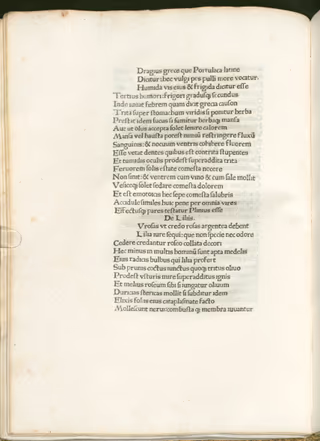
Vroſas vt credo roſas argentea debent
Lilia iure ſequi: que non ſpecie nec odore
Cedere credantur roſeo collata decori
Hec minus in multis hominū ſunt apta medelis
Eius radicis bulbus qui lilia profert
Sub prunis coctus iunctus quoqꝫ tritus oliuo
Prodeſt vſturis mire ſuperadditus ignis
Et melius roſeum ſibi ſi iungatur oliuum
Duricias ſtericas mollit ſi ſubditur idem
Elixis foliis eius cataplaſmate facto
Molleſcunt nerui: combuſtaqꝫ membra iuuantur
Sicqꝫ ſuperpoſitis morſus curabitur anguis
Aut ſi cum vino bulbus potabitur ille
Sic quoqꝫ fungorum vetat ille venena nocere
Hunc vino coctum tritumqꝫ pedum ſuperadde
Clauis: nec ſoluas niſi cum lux tertia tranſit
Pingui porcino ſi decoquis hanc vel oliuo
Reddere poſſe pilos membris narratur aduſtis
Cum vino potus nocuum purgare cruorem
Per ventrem dicunt: & ſic prodeſſe lieni
Sicqꝫ iuuat vuluas: ſic idem meſtrua purgat
Vel ſi cum vino ventri coctum ſuperaddas
Preciſis neruis tritus cum melle medetur
Expreſſus ſucus foliorum miſtus aceto
Et melle coquitur ſi mellis ſint & aceti
Vt gemine partes predicti quinqꝫ liquoris
Ad deſiccandas nil eſt magis vtile plagas
Inqꝫ cicatrices ducit licet inueteratas
Elixus bulbus ac cerotis bene miſtus
Rugas deducit vultus maculas fugat omnes
Lichinas purgat: faciem quoqꝫ furfure mundat
Exprimitur ſucus de tritis floribus eius
Qui mollit vuluas: cum lana ſubditur illis
Illitus aſſeritur ſudorem poſſe mouere
Turgida maturat poſt concoquit: & cito mundat