Hover or tap a word to see its match.
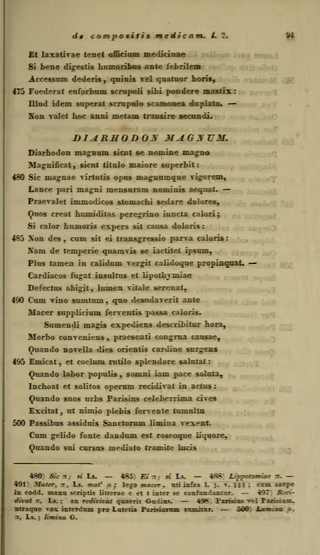
*Diarhodon magnum*, just as it magnifies itself by a great name,
Just as it takes pride in a greater title:
Thus a work of great virtue and great vigor,
With an equal balance, it equals the measure of its great name. —
It prevails in calming the immoderate pains of the stomach,
Which humidity joined to a foreign heat creates;
If heat devoid of humor should be the cause of the pain:
Do not give it, since it has a small transgression of heat:
For although it boasts itself of temperance,
It nevertheless inclines more towards the hot, and approaches the hot. —
It puts to flight cardiac attacks and drives away the failing
Of lipothymia, it clears the vital light,
When taken with wine, in which beforehand
The macer has sweated out, having suffered the punishment of boiling heat.
The more expedient hour of taking it is described,
Convenient for the disease, agreeable to the present cause,
When the new day rising from the hinge of the east
Shines forth, and greets the sky with ruddy splendor:
When work for the peoples, with the peace of sleep now dissolved,
Begins and falls back into the accustomed acts of tasks:
When the most celebrated city of Paris rouses its citizens,
So that with the excessive boiling tumult of the people
They vex the thresholds of the Saints with continuous steps.
It must be given with cold spring water and rosy liquor,
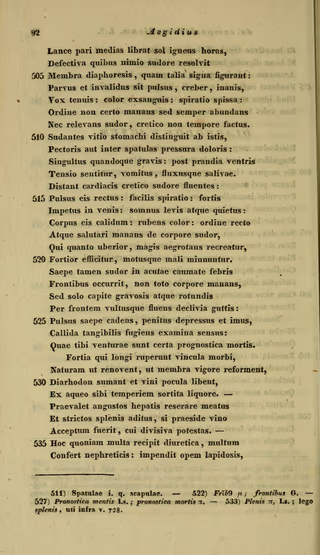
When by the halved path of the light of its course
The fiery sun balances the middle hours with an equal scale,
At which diaphoresis relaxes the failing
Limbs with excessive sweat, which such signs indicate:
The pulse is small and weak, frequent, empty,
The voice thin: the color bloodless: the breathing rapid:
Flowing in no certain order but always abundant
And not relieving, the sweat not occurring at a critical time.
One distinguishes those sweating from a defect of the stomach from these,
By a pressure of pain in the chest or between the shoulder blades:
Sometimes a severe hiccup: after meals a tension
Of the belly is felt, vomiting, and a flow of saliva.
Those flowing with a critical sweat differ from cardiac sufferers:
Their pulse is regular: breathing easy: strong
The impulse in the veins: sleep light and peaceful:
Their body is warm: color ruddy: the sweat flowing
From the body in a proper and healthful order,
Which the more abundant it is, the more the patient is restored,
Is made stronger, and the bad motions are diminished.
Often, however, sweat in the burning heat of an acute fever
Occurs on the forehead, not flowing from the whole body,
But flowing only from the head with heavy and round
Drops downwards over the forehead and face:
The pulse often falling, deeply depressed and low,
Fleeing the cunning examinations of the sense of touch:
Which are for you certain prognostics of coming death.
Those who have broken the strong bonds of a long illness,
In order to renew their nature, to restore their limbs with vigor,
Let them take *Diarhodon* and drink cups of wine,
Having obtained a tempering for themselves from a watery liquor. —
It is highly effective at unsealing the narrow passages of the liver
And the tight approaches of the spleen, if it has been taken
With wine presiding, which has divisive power. —
Since this receives many diuretics, it contributes
Much to nephritics: it bestows aid on those with stones,
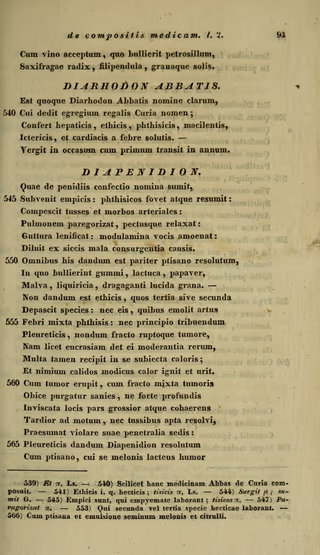
Taken with wine, in which parsley,
Saxifrage root, dropwort, and gromwell seeds have boiled.
Diarhodon magnum sicut se nomine magno
Magnificat, sicut titulo maiore superbit:
Sic magnae virtutis opus magnumque vigorem,
Lance pari magni mensuram nominis aequat. —
Praevalet immodicos stomachi sedare dolores,
Quos creat humiditas peregrino iuncta calori;
Si calor humoris expers sit causa doloris:
Non des, cum sit ei transgressio parva caloris:
Nam de temperie quamvis se iactitet ipsum,
Plus tamen in calidum vergit calidoque propinquat. —
Cardiacos fugat insultus et lipothymiae
Defectus abigit, lumen vitale serenat,
Cum vino sumtum, quo desudaverit ante
Macer supplicium ferventis passa caloris.
Sumendi magis expediens describitur hora,
Morbo conveniens, praesenti congrua causae,
Quando novella dies orientis cardine surgens
Emicat, et coelum rutilo splendore salutat:
Quando labor populis, somni iam pace soluta,
Inchoat et solitos operum recidivat in actus:
Quando suos urbs Parisius celeberrima cives
Excitat, ut nimio plebis fervente tumultu
Passibus assiduis Sanctorum limina vexent.
Cum gelido fonte dandum est roseoque liquore,
Quando sui cursus mediato tramite lucis
Lance pari medias librat sol igneus horas,
Defectiva quibus nimio sudore resolvit
Membra diaphoresis, quam talia signa figurant:
Parvus et invalidus sit pulsus, creber, inanis,
Vox tenuis: color exsanguis: spiratio spissa:
Ordine non certo manans sed semper abundans
Nec relevans sudor, cretico non tempore factus.
Sudantes vitio stomachi distinguit ab istis,
Pectoris aut inter spatulas pressura doloris:
Singultus quandoque gravis: post prandia ventris
Tensio sentitur, vomitus, fluxusque salivae.
Distant cardiacis cretico sudore fluentes:
Pulsus eis rectus: facilis spiratio: fortis
Impetus in venis: somnus levis atque quietus:
Corpus eis calidum: rubens color: ordine recto
Atque salutari manans de corpore sudor,
Qui quanto uberior, magis aegrotans recreatur,
Fortior efficitur, motusque mali minuuntur.
Saepe tamen sudor in acutae caumate febris
Frontibus occurrit, non toto corpore manans,
Sed solo capite gravosis atque rotundis
Per frontem vultusque fluens declivia guttis:
Pulsus saepe cadens, penitus depressus et imus,
Callida tangibilis fugiens examina sensus:
Quae tibi venturae sunt certa prognostica mortis.
Fortia qui longi ruperunt vincula morbi,
Naturam ut renovent, ut membra vigore reforment,
Diarhodon sumant et vini pocula libent,
Ex aqueo sibi temperiem sortita liquore. —
Praevalet angustos hepatis reserare meatus
Et strictos splenis aditus, si praeside vino
Acceptum fuerit, cui divisiva potestas. —
Hoc quoniam multa recipit diuretica, multum
Confert nephreticis: impendit opem lapidosis,
Cum vino acceptum, quo bullierit petrosillum,
Saxifragae radix, filipendula, granaque solis.