Hover or tap a word to see its match.
*Miclete* is a special cure for dysentery
and for lientery, but unequal purgation
divides them, and a differing practice of medicating is suitable,
for a varying humor separates the varying species,
and the varied nature of the cause varies the remedy.
If you care to bestow a cure upon dysenteric patients:
and a tincture of choler appears through all the stools,
Which the rosy liquor has imbibed from myrobalans,
You will purge them with citrine ones; if earthy humor
And black have been mixed in, you will also mix in Indic ones;
But if the humor of phlegmatic mucilage
Mixes itself in, the decoction demands the addition of Chebulic myrobalans.
To comfort the stomach, Rhodozaccara should be given,
After the purgation has reached its end,
And the next day has partly passed, Miclete should be given,
Which establishes for itself the rights of the second morning.
You will give this with the juice of plantain, from hematite
Struck against a whetstone, drawing a red color.
But if the sick person despises such mixtures,
And his nature cannot tolerate harmful drinks,
But rejects and shuns excessively harsh flavors,
You will give this in pills of hypocistis and of roses,
Of mastic and bole, with the powder of burnt gum
Mixed in, so that the substance becomes of solid form.
Notice this, however, and fixedly with a faithful mind
Gather it, because you will be able to distinguish it by its proper signs:
If from the lower intestine there occurs
The force of dysentery, it will rather help with a clyster;
A sitz bath, fomentation, smoke, poultice, wash,
And Miclete itself dissolved in the former juice,
Sent through the downward path, will benefit this condition:
If the origin of the flux arises from the highest,
Medicine taken through the mouth is more acceptable,
Nor does a poultice of Miclete bring little help
Applied to the belly, to which, mixed in, may provide strength
Burnt gum, rose, mastic, bole, vinegar,
Olibanum, juice of plantain, and the liquid of an egg.
This suitable order of curing lienteric patients
Is more expedient: first to purge the harmful
humor of the body, and finally to constrict the flux.
For unless a preceding purgation purges the noxious things,
and purifies the bad things, the constrictive force of *Miclete*,
while it retains the noxious, while it shuts in all superfluities,
while it curbs the bile, and sets up barriers against it,
accumulates the matter of the flux, which, since it is abundant,
unable to be closed inside, now with the prison broken
bursts forth more strongly and, disdaining to be held,
compels the flux to run with loosened reins.
That concoction serves lienteric patients with devoted love,
which contains within itself the fungus whose name is agaric,
and oak fern, and camel's straw,
and the grains which colocynth turns to medical uses.
If this is dissolved with rose liquor,
when drunk, it restrains flowing hemorrhoids,
and cotton, which has absorbed such a medicine,
must be fitted to the places and placed beneath the private parts;
it settles the rumbling of the belly and composes the strife of pain
caused by bile with a treaty of peace.
*Miclete* chastises the worm, and wards off the bite of putrefaction,
because it consists of dry species,
and a dry force is proven to be more preservative. —
Uncorrupted, it lasts by its own right for three years,
nor can ruinous old age encrust it. —
Its dose is established to be as much as an ounce weight holds.
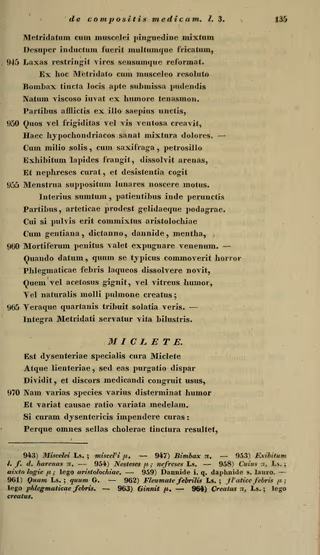
Est dysenteriae specialis cura Miclete
Atque lienteriae, sed eas purgatio dispar
Dividit, et discors medicandi congruit usus,
Nam varias species varius disterminat humor
Et variat causae ratio variata medelam.
Si curam dysentericis impendere curas:
Perque omnes sellas cholerae tinctura resultet,
Quos liquor imbiberit roseus de myrobalanis
Citrinis purgabis eos; si terreus humor
Et niger admixtus fuerit, miscebis et indos;
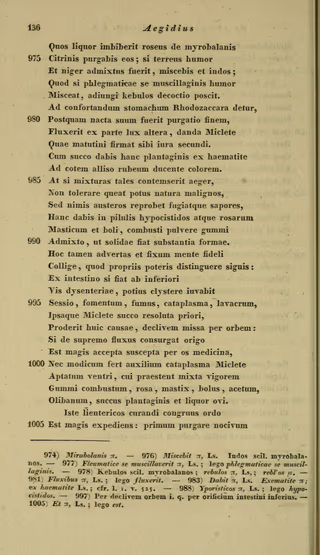
Quod si phlegmaticae se muscillaginis humor
Misceat, adiungi kebulos decoctio poscit.
Ad confortandum stomachum Rhodozaccara detur,
Postquam nacta suum fuerit purgatio finem,
Fluxerit ex parte lux altera, danda *Miclete*
Quae matutini firmat sibi iura secundi.
Cum succo dabis hanc plantaginis ex haematite
Ad cotem alliso rubeum ducente colorem.
At si mixturas tales contemserit aeger,
Non tolerare queat potus natura malignos,
Sed nimis austeros reprobet fugiatque sapores,
Hanc dabis in pilulis hypocistidos atque rosarum
Masticum et boli, combusti pulvere gummi
Admixto, ut solidae fiat substantia formae.
Hoc tamen advertas et fixum mente fideli
Collige, quod propriis poteris distinguere signis:
Ex intestino si fiat ab inferiori
Vis dysenteriae, potius clystere iuvabit
Sessio, fomentum, fumus, cataplasma, lavacrum,
Ipsaque *Miclete* succo resoluta priori,
Proderit huic causae, declivem missa per orbem:
Si de supremo fluxus consurgat origo
Est magis accepta suscepta per os medicina,
Nec modicum fert auxilium cataplasma *Miclete*
Aptatum ventri, cui praestent mixta vigorem
Gummi combustum, rosa, mastix, bolus, acetum,
Olibanum, succus plantaginis et liquor ovi.
Iste lientericos curandi congruus ordo
Est magis expediens: primum purgare nocivum
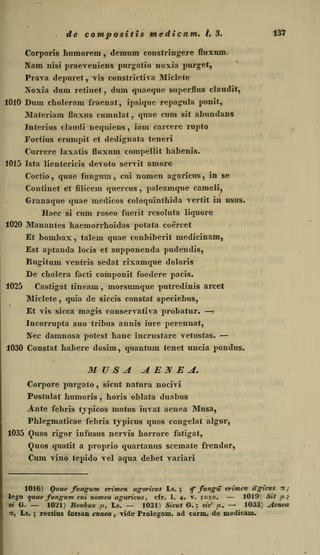
Corporis humorem, demum constringere fluxum.
Nam nisi praeveniens purgatio noxia purget,
Prava depuret, vis constrictiva Miclete
Noxia dum retinet, dum quaeque superflua claudit,
Dum choleram fraenat, ipsique repagula ponit,
Materiam fluxus cumulat, quae cum sit abundans
Interius claudi nequiens, iam carcere rupto
Fortius erumpit et dedignata teneri
Currere laxatis fluxum compellit habenis.
Ista lientericis devoto servit amore
Coctio, quae fungum, cui nomen agaricus, in se
Continet et filicem quercus, paleamque cameli,
Granaque quae medicos coloquinthida vertit in usus.
Haec si cum roseo fuerit resoluta liquore
Manantes haemorrhoidas potata coërcet
Et bombax, talem quae conbiberit medicinam,
Est aptanda locis et supponenda pudendis,
Rugitum ventris sedat rixamque doloris
De cholera facti componit foedere pacis.
Castigat tineam, morsumque putredinis arcet
Miclete, quia de siccis constat speciebus,
Et vis sicca magis conservativa probatur. —
Incorrupta suo tribus annis iure perennat,
Nec damnosa potest hanc incrustare vetustas. —
Constat habere dosim, quantum tenet uncia pondus.