De viribus herbarum: A Latin herbal poem on the powers of plants
By Macer Floridus (traditionally Odo of Meung) · Published 1477 · Latin with English translation · Bayerische Staatsbibliothek
Historian’s note. This text records the medicine of its own time, and later evidence has replaced most of it. It is not medical advice. We read it as history, and we ask what, if anything, connects it to medicine today.
Historian’s note. This text records the medicine of its own time, and later evidence has replaced most of it. It is not medical advice. We read it as history, and we ask what, if anything, connects it to medicine today. More on how we read old medical books
We have not yet reviewed the translation of this book.
De viribus herbarum
A Latin herbal poem on the powers of plants
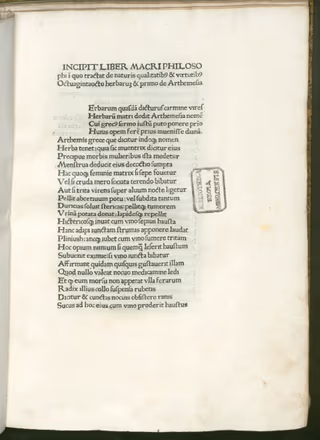
By Macer Floridus (traditionally Odo of Meung), 1477. The edition has the page scans, the Latin text, and an English translation.
De viribus herbarum (“On the powers of herbs”) is a Latin poem in hexameters on the medical uses of plants. It was written in the Loire valley in the late eleventh century, probably by Odo of Meung, under the name “Macer Floridus.” Each of its 77 chapters names a herb, gives its degree of heat and dryness, and lists the illnesses it treats and how to prepare it. This edition is the first printing, made at Naples on 9 May 1477, with 88 chapters that include later additions.
The 1477 Naples edition is the first printed herbal of any kind. The poem draws on Pliny, the Pseudo-Apuleius Herbarius and Walafrid Strabo’s Hortulus, and shows no trace of the Arabic medicine then reaching Salerno. Its chapter on the poppy sets a safe dose, “the weight of a denarius,” and warns that “a larger amount more often brings lethargy or death.” More than 200 Latin manuscripts survive. The poem was translated into German, French, English, Hebrew and other languages.
| Date | Place | Work | Notes |
|---|---|---|---|
| c. 840 | Reichenau | Liber de cultura hortorum (Hortulus) By Walafrid Strabo | A Latin hexameter poem on 23 herbs of Walafrid’s monastery garden at Reichenau. It set the model for herbal lore in verse. De viribus herbarum draws on it, along with Pliny’s Natural History and the Pseudo-Apuleius Herbarius. |
| Late 1000s | Loire valley | De viribus herbarum By Odo of Meung (Macer Floridus) | A poem of about 2,269 hexameters on 77 herbs, opening with mugwort, the “mother of herbs.” A twelfth-century manuscript at Dresden names the author as Odo of Meung. Medieval readers confused “Macer Floridus” with the Augustan poet Aemilius Macer, whose herbal poem is lost. Sigebert of Gembloux cited the poem by 1112. |
| 1477 | Naples | De viribus herbarum | Printed by Arnaldus de Bruxella on 9 May 1477, without illustrations. Its opening announces 88 herbs, because chapters such as De Pimpinella and De Tormentilla had been added to the poem in the manuscript copies. A Milan edition followed in 1489. |
Poems
87 poems, grouped by theme.
Medical knowledge · 32
- De Aneto.
- De Aprotano.
- De Atriplici.
- De Camereos vľ Germandea.
- De Cepis.
- De Cerofolio.
- De Cimino.
- De Cinnamo.
- De Cypero.
- De Eſtrocio al̓s Caulicula agreſti
- De Feniculo
- De Galanga.
- De Lactuca.
- De Lapacio al̓s Paratella.
- De Malua.
- De Marubeo al̓s Prauiore.
- De Naſturcio.
- De Nepta.
- De Origano.
- De Pionia.
- De Pipere.
- De Piretro.
- De Porris.
- De Portulaca.
- De Rafano.
- De Sauina
- De Sinapio
- De Stringa al̓s Morella.
- De Thure.
- De Yſopo
- De Zedoari.
- De Zinzibre.
Natural world · 28
- De Aloe.
- De Altea.
- De Apio.
- De Aſaro.
- De Bertonica.
- De Camomilla.
- De Cauli.
- De Celedonia.
- De Centaurea.
- De conſolida.
- De Eleboro.
- De Ematite.
- De Enula.
- De Iri.
- De Iuſquiamo al̓s Caniculata.
- De Liguſtia.
- De Liliis.
- De Lolio al̓s Nigella.
- De Paſtinaca.
- De Plantagine.
- De Quinqꝫfolio ſeu Pantafilon.
- De Roremarino.
- De Roſa.
- De Ruta.
- De Serpillo
- De Titimallo.
- De Viola.
- De Vrtica